

-
About us
 Tianjin lefin Industrial
TIANJIN LEFIN STEEL GROUP containing Tianjin lefin Industrial Co.,Ltd. 、Tianjin lefin steel import & export Co.,Ltd and Tianjin Shengqifeng International Trading Co., Ltd. -
Products
Steel Pipe Processing
Our main products include 1/2inch to 16 inch ERW PIPE/GI PIPE which has been produced according to BS1387/ASTM A53/EN10219/EN10255/EN10217 Standard -
-
Service Capability
Guarantee Quality
Our steel pipes are suitable for oil, natural gas, shipbuilding, chemical industry, water conservancy, electrical, steel structure, construction and other related fields.
The Manufacturing Process, Steps, Precautions, Applications And Features Of Seamless Square Tubes
Release time:
2026-01-19
Seamless square tubes are square-sectioned steel pipes without welds. They differ from welded square tubes. The raw materials are deformed plastically to form a square shape directly, and the overall structure is continuous, possessing excellent mechanical properties.
The following provides a detailed explanation from five aspects: manufacturing process, production steps, precautions, application fields, and product features:
I. Core manufacturing process and production steps of seamless square tubes
The manufacturing of seamless square tubes is based on hot-rolled seamless round tube billets. Through subsequent cold processing or hot rolling forming, a square cross-section is obtained. The mainstream processes include cold drawing/cold rolling forming process and hot rolling forming process. A small number of special specifications adopt extrusion forming process.
· Cold drawing/cold rolling forming process (mainstream, suitable for small-diameter, high-precision seamless square pipes)
This process is suitable for producing seamless square pipes with uniform wall thickness, high dimensional accuracy, and smooth surface. It is currently the most widely used process route.
1. Raw material preparation
Select standard hot-rolled seamless round pipes (coated pipes) as raw materials. The requirements for the outer diameter, wall thickness tolerance, and surface quality of the coated pipes must meet the standards. Common materials include Q235, Q345, 20 steel, 45 steel, etc.
2. Acid washing and lubrication
- Acid washing:
Place the coated pipes in a hydrochloric acid solution to remove the oxide scale and rust on the surface, avoiding damage to the molds during subsequent cold drawing.
- Lubrication:
After acid washing, clean and dry the pipes, and then apply a special lubricant (such as soap solution, graphite lubricant) to the inner and outer walls of the pipes to reduce the friction during cold drawing.
3. Cold drawing forming
Apply the lubricant to the coated pipes and pass them through a cold drawing machine and a special square mold for drawing. This causes the pipe billet to undergo plastic deformation, gradually changing from a circular shape to a square shape.
- If the deformation amount is too large, it may cause the pipe to crack. Therefore, multiple passes of drawing are required, adjusting the mold size each time to gradually approach the target square pipe specifications.
4. Intermediate annealing
After multiple cold drawing processes, the pipe will undergo work hardening (increased hardness, decreased plasticity), so annealing treatment is necessary: Place the pipe in an annealing furnace, heat it to above Ac3 temperature (generally 750-900°C), hold for a while, and then slowly cool to eliminate internal stress and restore plasticity, so as to facilitate subsequent drawing.
5. Precise diameter setting and straightening
- Diameter setting:
Use a diameter setting machine and square diameter setting molds to calibrate the length, diagonal, and wall thickness tolerance of the square pipes, ensuring they meet the standards.
- Straightening:
Use a pressure straightening machine or roller straightening machine to correct the bending and twisting deformations of the square pipes to ensure straightness.
6. Cutting the ends and inspection
- Cutting the ends:
Remove the irregular parts at both ends to ensure consistent length.
- Inspection:
Conduct size inspection, surface quality inspection, non-destructive testing (ultrasonic testing, eddy current testing, to detect internal defects), and mechanical property tests (tensile, hardness testing).
7. Finishing and packaging
Apply surface anti-rust treatment (such as galvanization, painting) to the qualified square pipes, then bundle, mark, and store them for sale.


· Hot rolling forming process (suitable for large-diameter, thick-walled seamless square tubes)
This process directly utilizes the high-temperature plasticity of the hot-rolled round tube billets for forming, with high production efficiency and suitable for large-sized products.
1. Heating of the round tube billet:
Send the solid round steel billet into the stepwise heating furnace and heat it to 1100-1250℃ to make the steel billet reach the optimal plastic state.
2. Piercing:
The high-temperature steel billet passes through the conical roller piercing machine and is rolled into a hollow hot-rolled tube.
3. Hot rolling squareization forming:
Send the hot-rolled tube billet into the square hole-type rolling machine and through the continuous rolling of multiple sets of rolling machines, the round tube gradually deforms into a square cross-section.
4. Gaging, straightening, and inspection:
The steps are the same as those in the cold drawing process, and there is no need for multiple annealing (the plasticity is good during hot rolling, and the degree of work hardening is low).
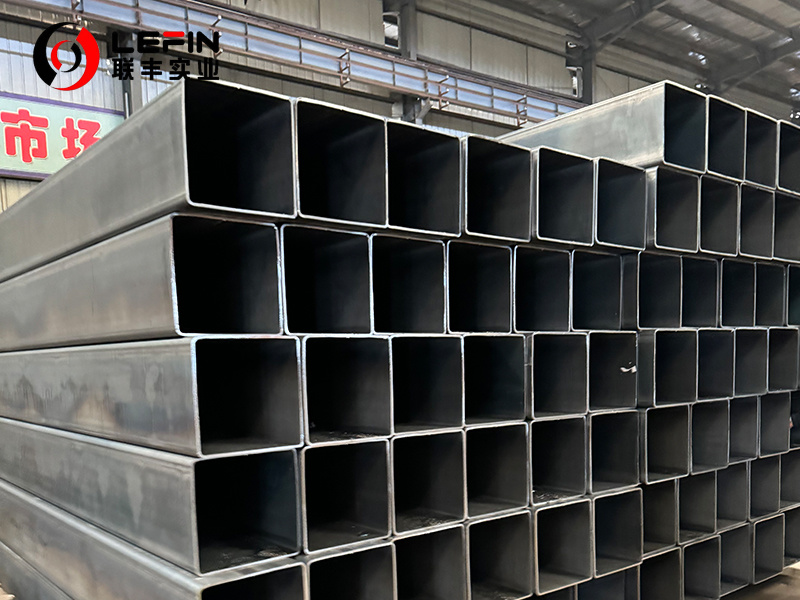

· Extrusion Molding Process (Rare, Suitable for Special Materials/Anisotropic Cross-Sections)
For materials that are difficult to deform, such as stainless steel and alloy steel pipes, or special square cross-sections (such as thick-walled and thin-walled difference large square pipes), the extrusion process is adopted: The heated round pipe billet is placed in the extrusion die, and high pressure is applied by the extrusion rod to extrude the pipe material out of the square die hole. This process has a large forming force and a high cost, and is only used for customized products.


II. Key Considerations in Seamless Tube Manufacturing
1. Material Quality Control
The chemical composition and purity of the billet or hot-rolled tube directly determine the quality of the finished product. The content of harmful elements such as sulfur and phosphorus must be strictly controlled to avoid defects such as porosity and slag inclusion.
2. Temperature Control
- During hot rolling/annealing, excessively high temperatures will result in coarse grains and overburning on the surface; excessively low temperatures will lead to insufficient plasticity and prone to cracking.
- Thorough lubrication and drying before cold drawing are necessary; otherwise, the residue of the lubricant will cause wear on the mold or scratches on the surface of the tube.
3. Deformation Control
For both cold drawing and hot rolling, the deformation amount in a single pass needs to be reasonably designed. Excessive deformation can easily cause uneven wall thickness and cracking at the edges; too little deformation will result in low production efficiency and difficulty in meeting dimensional accuracy requirements.
4. Internal Stress Elimination
The work hardening and internal stress after cold drawing are the main causes of subsequent cracking of the tube. They must be eliminated through sufficient annealing. The annealing temperature and holding time need to be adjusted according to the material.
5. Dimension and Defect Inspection
- Key dimensions (length, wall thickness, diagonal difference) need to be inspected on each tube to avoid "rectangular tubes" (unequal diagonals).
- Non-destructive testing should cover all products, focusing on detecting concealed defects such as internal shrinkage and cracks to ensure safety under high-pressure conditions.
6. Rust Prevention Treatment
Finished seamless tubes need to be promptly treated for rust prevention, especially for carbon steel materials, to avoid rusting during storage or transportation.
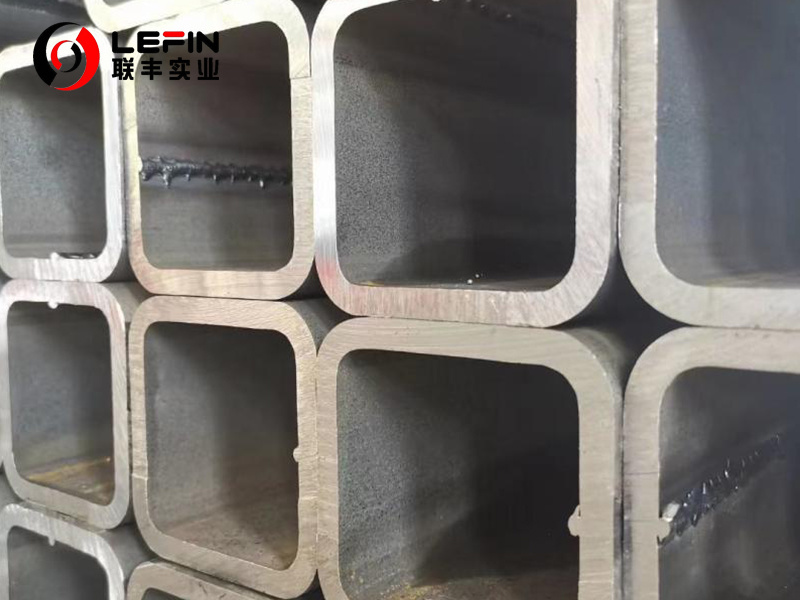

III. Main application fields of seamless square tubes
Seamless square tubes are widely used in various fields due to their lack of weld seams, high strength, and good sealing performance. They are particularly suitable for scenarios with high pressure, heavy loads, and high safety requirements. The specific applications are as follows:
1. Mechanical manufacturing
Used to manufacture heavy-load components such as machine tool beds, engineering machinery arms, agricultural machinery frames, automotive chassis crossbeams, transmission shaft sleeves, etc. Their excellent bending and torsion resistance properties are utilized.
2. Fluid transportation
Suitable for high-pressure fluid transportation, such as hydraulic system pipelines, chemical high-pressure medium pipelines (oil, natural gas, acid-base solutions), boiler steam pipelines, etc. The seamless structure can avoid the risk of weld leakage.
3. Steel structure engineering
Used in large-span steel structure frameworks, support columns, curtain wall keels, etc. Compared to welded square tubes, seamless square tubes have stronger load-bearing capacity and are suitable for heavy-load structures in high-rise buildings, bridges, and factories.
4. Petrochemical and power industries
Used in support brackets of oil drilling platforms, oil pipelines, load-bearing components of power towers, and auxiliary pipeline systems of nuclear power plants, etc. They can withstand harsh conditions such as high pressure and corrosion.
5. Military and aerospace fields
Some high-strength alloy seamless square tubes are used in key components of weapons equipment, aircraft engine brackets, etc. The requirements for size accuracy and mechanical properties are extremely high.
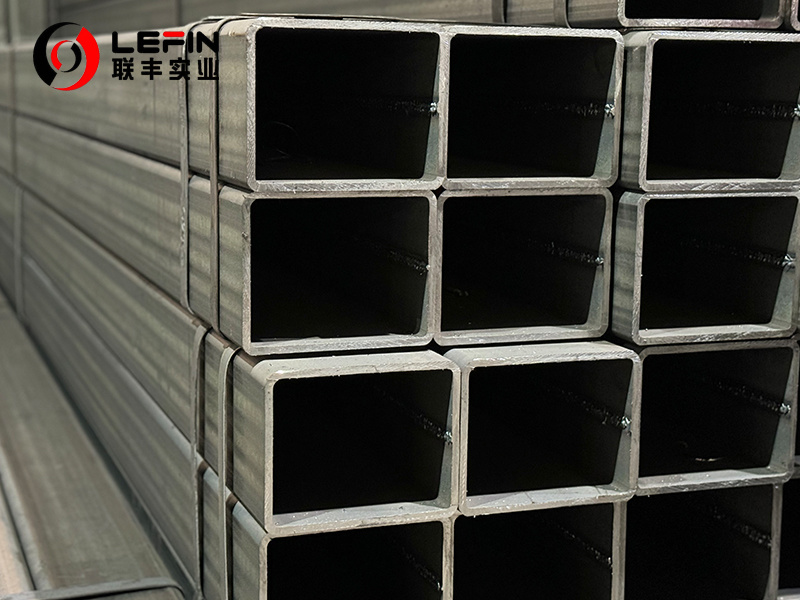
IV. Core Features of Seamless Square Tubes
| Feature | Detailed Explanation |
| Excellent mechanical properties | Without weld seams, the overall structure is continuous. The tensile strength, yield strength, and impact resistance are all higher than those of welded square tubes of the same specification, and it can withstand higher pressure and loads. |
| High dimensional accuracy | The seamless square tubes produced by the cold drawing process have a length tolerance of ±0.1mm for the side length, uniform wall thickness, and a small diagonal difference. They are suitable for precision mechanical processing. |
| Excellent sealing performance | No weld defects, capable of withstanding high-pressure fluid transportation, and will not have the leakage problem of welds in welded pipe sections, suitable for the transportation of flammable, explosive and toxic media. |
| Excellent processing performance | It can undergo various processing operations such as cutting, bending, drilling, and welding (for connection with other components). After cold processing, it can be restored to plasticity through annealing, meeting the requirements for complex shaping. |
| Excellent corrosion resistance | The surface is smooth and free of weld seam protrusions. Subsequent processes such as galvanization, spraying, and passivation can be carried out to enhance the corrosion resistance, making it suitable for harsh environments such as dampness, acid, and alkali. |
| Higher cost | Compared to welded square tubes, the production process is more complex, with higher raw material and processing costs. It is suitable for scenarios with strict performance requirements. For ordinary structural components, welded square tubes are more commonly used. |
Tags:
Relevant Project
Address: Hengtai Road,Daqiuzhuang Town,Jinghai County,Tianjin,China
Mob: +8615122229899(whatspp)
Phone: +86 22 58171905
Fax: +86 22 58171902
E-mail:info@lefinsteel.com
Get company updates
Tianjin Lefin Industrial Co.,Ltd. All rights reserved City sub-station SEO www.300.cn