

-
About us
 Tianjin lefin Industrial
TIANJIN LEFIN STEEL GROUP containing Tianjin lefin Industrial Co.,Ltd. 、Tianjin lefin steel import & export Co.,Ltd and Tianjin Shengqifeng International Trading Co., Ltd. -
Products
Steel Pipe Processing
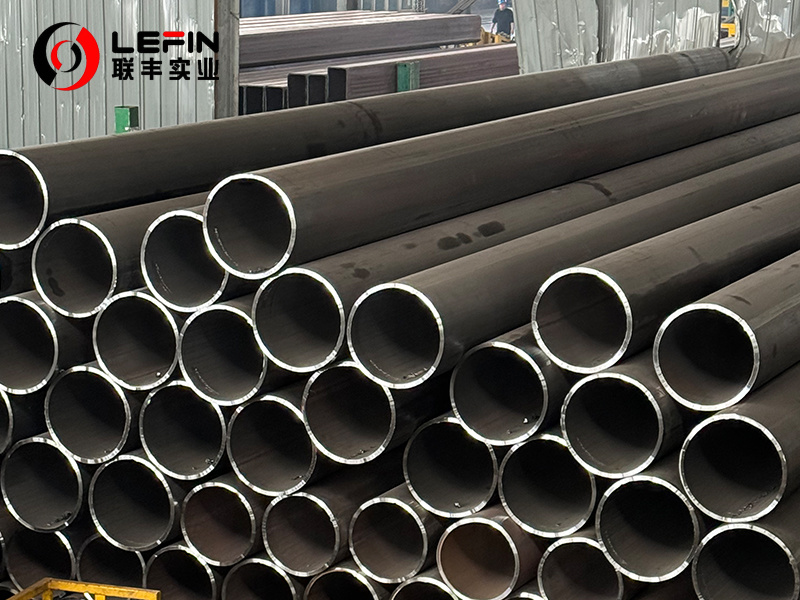
Our main products include 1/2inch to 16 inch ERW PIPE/GI PIPE which has been produced according to BS1387/ASTM A53/EN10219/EN10255/EN10217 Standard -
-
Service Capability
Guarantee Quality
Our steel pipes are suitable for oil, natural gas, shipbuilding, chemical industry, water conservancy, electrical, steel structure, construction and other related fields.
Straightening Of Seamless Steel Pipe
Release time:
2026-07-10
I. Core Factors Affecting the Curvature of Seamless Steel Pipes
The bending deformation of seamless steel pipes (ERW high-frequency welding, LSAW submerged arc welding, etc.) is essentially caused by the uneven distribution of internal stress + asymmetry in external force / thermal effects. The core influencing factors can be classified into four categories:
1. Raw materials and inherent stress factors
- Steel strip residual stress during rolling: Uneven cooling and deformation during rolling result in residual stress within the steel strip / sheet. After rolling into a pipe, the stress is released, causing the pipe to bend spontaneously.
- Material performance inhomogeneity: Carbon, manganese, etc. element segregation in the billet, or uneven thickness of the steel strip (transverse wall thickness difference), leads to differences in local strength and deformation resistance, resulting in asymmetric deformation after processing.
- Material anisotropy: There are differences in fiber flow direction during rolling of the sheet, and the mechanical properties in the transverse and longitudinal directions are different. After forming, the stress distribution is asymmetric along the circumferential direction.
2. Deviations in forming processes
- Rolling system and mold deviation: Deviations in the wear of the forming rolls, uneven press-down force, or deviation in the centerline of the mold cause inconsistent curvature of the pipe billet and different extension amounts on both sides. In severe cases, it can lead to spiral twisting of the pipe body.
- Tension and feeding deviation: Insufficient tension in the unwinding section, skew of the feeding guide plate, and the steel strip being fed at an oblique angle into the forming section result in cumulative bending deviations starting from the first pass.
- Incorrect pre-bending and forming parameters: Inadequate edge pre-bending, unreasonable JCO forming step distance / mold opening degree, causing stress concentration in the pipe section and overall straightness exceeding the standard after forming.
3. Welding thermal deformation (the most prominent special cause for seamless steel pipes)
- Asymmetric welding heat input: When welding on one side, the weld side is concentratedly heated, and the cooling contraction is significantly greater than that of the base material, causing the pipe body to bend towards the weld side (commonly known as "welding bend"); if the internal and external heat input in double-sided welding is not uniform, the same problem will occur.
- The "rib effect" of weld excess height: Uneven excess height on the inside and outside of the weld, equivalent to forming a reinforcement on one side of the pipe body, restricting deformation on that side and causing overall curvature deviation.
- Pipe end "pouting" defect: The processing and welding deformation at both ends of the weld do not match, resulting in local warping at the pipe end, which not only affects the perpendicularity of the end face but also amplifies the overall straightness deviation.
4. Subsequent processes and external force factors
- Uneven cooling: There are temperature differences between the top and bottom, left and right of the pipe after welding, and different contraction rates at each part, resulting in thermal stress bending.
- Expansion and water pressure processes: Inappropriate expansion parameters, non-uniform strain rate along the axial direction, or residual stress redistribution after water pressure testing will expose potential bending and even cause new deformations.
- Lifting and stacking: Insufficient lifting points for long pipes, or excessive stacking layers, will cause plastic bending due to gravity, which is a post-cast deformation caused by external forces.
II. Reasons Why Seamless Steel Pipes Must Be Straightened
Straightening is a key process in seamless steel pipe production to ensure dimensional accuracy and performance. The core necessity lies in the following aspects:
1. Meeting assembly and construction accuracy requirements
- Pipe end processing requirements: Oil tubing, mechanical pipes require threading, and most threading processes are pipe rotation-based. Excessive straightness deviation will cause eccentricity in the threads and failure of connection sealing; deviation in straightness will also cause uneven processing of the pipe end groove and excessive cutting deviation.
- On-site connection efficiency: In the construction of long-distance pipelines and structural pipe networks, bent steel pipes cannot be precisely aligned and require on-site secondary correction or cutting, which significantly increases construction costs and construction periods. When laid over long distances, small deviations of individual pieces can accumulate into huge overall offsets.
2. Ensuring safety and service life
- Structural safety: As structural supports or mechanical shafts, bending will cause local stress concentration, and long-term service is prone to fatigue fracture.
- Transportation performance: The curved inner wall of the fluid transport pipe will form turbulence, increasing transportation resistance and accelerating local corrosion, shortening the pipe's service life.
- Coating quality: In 3PE and other coating operations, bending pipes will cause uneven coating thickness and failure of the thin areas of the coating, leading to pipeline corrosion hazards.
3. Eliminate and homogenize residual stress
- Straightening is achieved through controlled reverse plastic deformation, which redistributes the forming and welding residual stress within the pipe body, reducing the stress peak and preventing the pipe from spontaneously deforming during subsequent processing, storage, or use, thereby stabilizing the dimensional accuracy.
4. Conform to product standard tolerances
- Mainstream standards such as API 5L, GB/T 3091, and GB/T 9711 all have clear requirements for the straightness of steel pipes (typically ≤ 0.15% L, with high precision requirements reaching ≤ 0.05% L). Straightening is a necessary process for meeting the standards and achieving factory delivery.
III. Straightening processes and methods during production
For straight seam steel pipe production, cold mechanical straightening is the main process, supplemented by hot straightening. At the same time, pre-processing is carried out to control the reduction of bending, forming a complete system of "prevention + rough straightening + fine straightening + supplementary straightening".
1. Mainstream cold straightening processes and equipment
(1) Multi-roller inclined roller straightening machine (core equipment for fine straightening)
- Working principle: It uses multiple sets of interleaved inclined curved straightening rollers (commonly six or seven roller structures), with the roller axis at a 25° to 35° inclination angle relative to the pipe axis; the lower roller drives the pipe to rotate and advance axially, while the upper roller applies a compressive force, causing the pipe to undergo repeated reverse bending around the circumference, through elastic-plastic deformation, gradually eliminating all directions of curvature.
- Applicable scenarios: Fine straightening of medium and small diameter ERW welded pipes, or supplementary fine straightening for large-diameter pipes, with straightening accuracy reaching within 0.2mm/m.
- Key parameter control: The roller spacing is 0.8 to 1.2 times the pipe diameter; the reduction amount should exceed the yield deformation of the material but be lower than the tensile strength, to avoid cracking or shrinkage; the straightening speed for carbon steel is usually 20 to 40m/min.
(2) Pressure straightening machine (local straightening for large-diameter pipes)
- Working principle: Based on the three-point bending mechanics principle, two supports hold the pipe body in a bent shape, and a concentrated pressure is applied to the highest point of the concave side of the pipe, causing the pipe to undergo reverse plastic deformation, and after rebounding, achieving the straightness requirement.
- Applicable scenarios: Local supplementary straightening for large-diameter thick-walled LSAW welded pipes, or for pipes with local hard bends, often used in conjunction with roller straightening.
- Process characteristics: It can monitor deflection in real time and adjust the reduction amount as needed; modern intelligent systems can automatically calculate the reduction parameters based on the initial deflection measurement, replacing manual experience.
(3) Coordinated straightening in the expansion process
- Cold expansion is a standard process for large-diameter straight seam submerged arc welded pipes, using molds to uniformly expand the pipe around the circumference, not only eliminating welding residual stress and improving roundness, but also reasonably controlling the expansion strain rate, which can significantly improve the overall straightness, controlling the straightness within 0.15% L, which is a key means of "preventing straightening in advance".
2. Hot straightening process (supplementary method)
The most commonly used is flame straightening:
- Operation method: On the convex side of the pipe bend, use an oxygen-ethane flame for strip or point heating, with the temperature controlled at 700 to 850℃ (the steel turns dark red), then cool naturally or with water, using the contraction deformation of the heating area to cancel the original bending.
- Applicable scenarios: Local large deformation correction in production lines, on-site repair, the heating width is usually no more than twice the pipe wall thickness, and strict temperature control is required to avoid overheating or material deterioration.
3. Straightening arrangement in the production process
Typical straight seam welded pipe production line straightening process arrangement:
Forming and welding → Weld seam leveling → Cold expansion → Rough straightening (parallel rollers / large roller spacing) → Fine straightening (inclined roller straightening machine) → Hydraulic test → (local supplementary straightening) → Pipe end processing → Finished product inspection
Tags:
Relevant Project
Address: Hengtai Road,Daqiuzhuang Town,Jinghai County,Tianjin,China
Mob: +8615122229899(whatspp)
Phone: +86 22 58171905
Fax: +86 22 58171902
E-mail:info@lefinsteel.com
Get company updates
Tianjin Lefin Industrial Co.,Ltd. All rights reserved City sub-station SEO www.300.cn