

-
About us
 Tianjin lefin Industrial
TIANJIN LEFIN STEEL GROUP containing Tianjin lefin Industrial Co.,Ltd. 、Tianjin lefin steel import & export Co.,Ltd and Tianjin Shengqifeng International Trading Co., Ltd. -
Products
Steel Pipe Processing
Our main products include 1/2inch to 16 inch ERW PIPE/GI PIPE which has been produced according to BS1387/ASTM A53/EN10219/EN10255/EN10217 Standard -
-
Service Capability
Guarantee Quality
Our steel pipes are suitable for oil, natural gas, shipbuilding, chemical industry, water conservancy, electrical, steel structure, construction and other related fields.
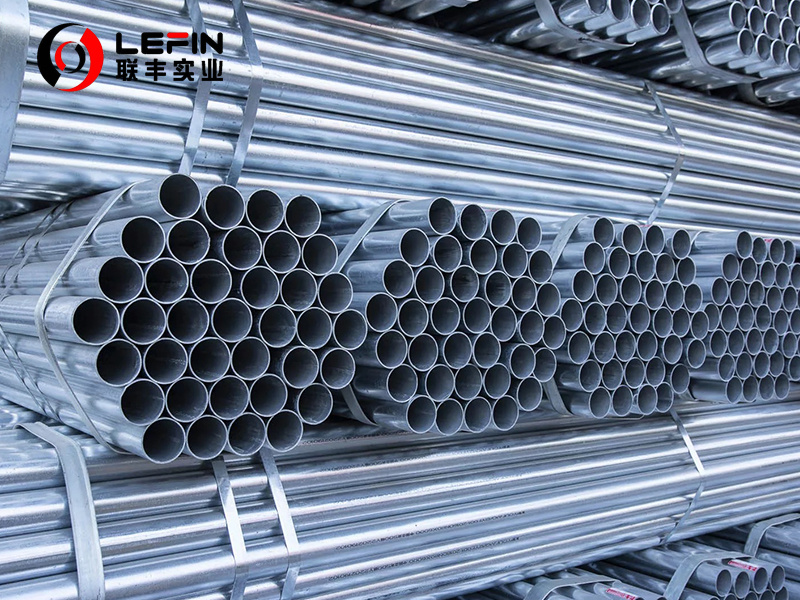
The Differences And Applications Between Galvanized Steel Pipes And Galvanized Seamless Pipes
Release time:
2026-01-05
Although galvanized steel pipes and galvanized seamless pipes have similar names, due to the differences in their core materials and manufacturing processes, their characteristics and applicable scenarios are significantly different. The following table can help you more intuitively understand their core distinctions.
| Galvanized steel pipe | Galvanized seamless steel pipe | |
| The base material | It is usually made by rolling and welding steel plates (welded pipe) | It is perforated from a single piece of round steel and has no weld seams |
| Core features | Excellent corrosion resistance (thanks to the galvanized coating) | High pressure-bearing capacity, strong mechanical properties, and uniformity throughout |
| Main disadvantages: | The weld is a potential weak point | The price is relatively high. |
| Characteristics of galvanized coating | The galvanized coating is relatively thick. | The galvanized coating is relatively thin. |

How to Make the Right Choice?
When making a choice, you can follow a basic principle: First, look at the pressure requirements.
- High-pressure fluid transportation: such as fire protection pipelines, air conditioning cold and hot water pipes, oil and gas transportation pipelines, and high-pressure water, gas and oil pipelines.
- Key structural components: such as the chassis and transmission shaft of a car, the framework and transmission system of mechanical equipment, and the supports and beams of a bridge.
- In situations where the lifespan and reliability of the pipeline are of utmost importance: such as in chemical equipment and power transmission.

• Scenarios where galvanized steel pipes can be used:Primarily for low-voltage, non-load-bearing protection and transportation applications.

- Architecture and decoration: such as guardrails, fences, balcony railings, scaffolding, and interior ceiling panels.
- Low-pressure fluid transportation: such as the water supply and drainage systems in buildings, and heating pipelines.
- General protection: such as cable conduits, road protection facilities, and agricultural greenhouse supports.
Tags:
Relevant Project
Address: Hengtai Road,Daqiuzhuang Town,Jinghai County,Tianjin,China
Mob: +8615122229899(whatspp)
Phone: +86 22 58171905
Fax: +86 22 58171902
E-mail:info@lefinsteel.com
Get company updates
Tianjin Lefin Industrial Co.,Ltd. All rights reserved City sub-station SEO www.300.cn