

-
About us
 Tianjin lefin Industrial
TIANJIN LEFIN STEEL GROUP containing Tianjin lefin Industrial Co.,Ltd. 、Tianjin lefin steel import & export Co.,Ltd and Tianjin Shengqifeng International Trading Co., Ltd. -
Products
Steel Pipe Processing
Our main products include 1/2inch to 16 inch ERW PIPE/GI PIPE which has been produced according to BS1387/ASTM A53/EN10219/EN10255/EN10217 Standard -
-
Service Capability
Guarantee Quality
Our steel pipes are suitable for oil, natural gas, shipbuilding, chemical industry, water conservancy, electrical, steel structure, construction and other related fields.
- Details
-
Introduction
Straight seam welded pipe is a type of steel pipe whose weld seam runs longitudinally along the axis of the pipe. It is made by rolling steel plates or steel strips into a tubular shape and then welding the butted edges together.
Its core feature is that the weld seam is a straight line. Compared to spiral welded pipes, straight seam welded pipes have higher dimensional accuracy and production efficiency, and they are one of the most widely used types of pipes ian fields such as oil and gas transportation, construction structures, and machinery manufacturing.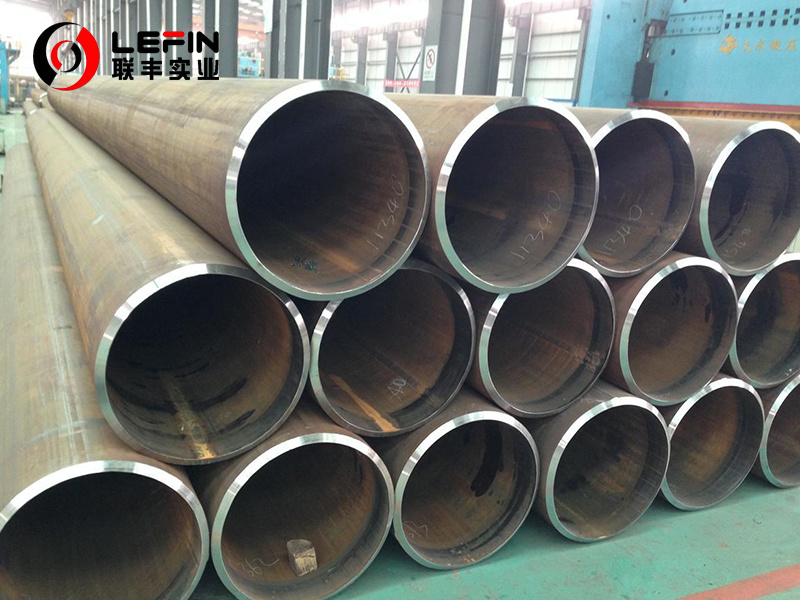
The production of straight seam welded pipes mainly involves the following key steps, each of which directly affects the quality and performance of the final product:
I. Unrolling and flattening
Unroll the steel coil and pass it through the flattening machine to eliminate the curling stress, ensuring the steel plate remains flat. This is the foundation for maintaining the accuracy of subsequent forming processes.
II. Shearing and Butt Welding
Cut the steel plates as needed and connect the ends of the plates through butt welding to achieve continuous production and reduce downtime.
III. Forming (Pre-bending and Continuous Forming)
- Pre-bending: Bend the edges of the steel plate on both sides in advance to reduce the edge stretching deformation during the subsequent forming process.
- Continuous forming: The flat plate is gradually rolled into an open tube billet (commonly known as the "JCO" or "UOE" process) through multiple sets of rollers, with the deformation amount controlled to avoid stress concentration.
IV. Welding
- High-frequency Resistance Welding (ERW): Suitable for small to medium-sized pipes. It uses high-frequency current to heat the edges of the pipe billet and then applies pressure for welding. It is highly efficient and cost-effective.
- Submerged Arc Welding (SAW): This method is used for large-diameter thick-walled pipes. A flux is applied at the weld seam for double-sided welding, resulting in high strength and stable quality. Remove the internal and external welding slag immediately after welding to ensure the weld is clean.
V. Diameter Control and Straightening
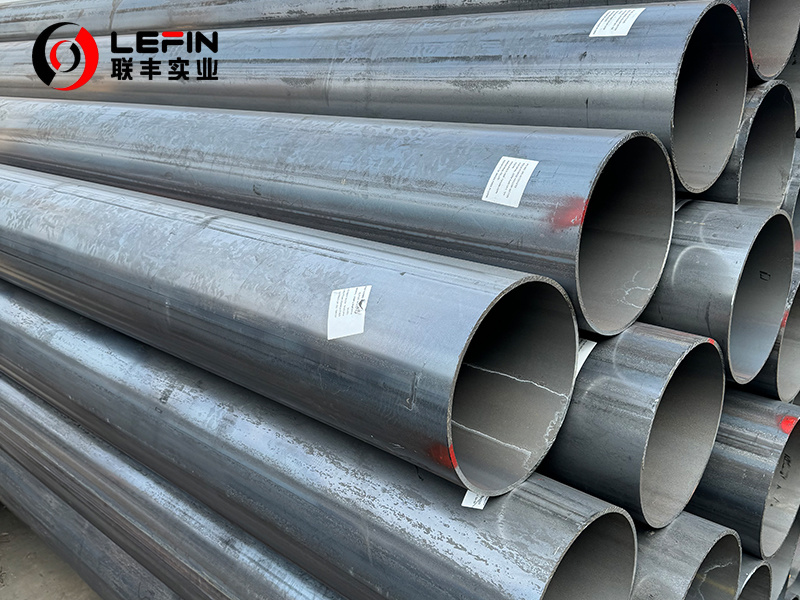
The welded pipes are first adjusted radially by the diameter control machine to ensure dimensional accuracy and roundness, and then the bending deformation is eliminated by the straightening machine.
VI. Cutting and End Face Treatment
The pipe is cut to a fixed length and the pipe ends are processed with beveling or flattened to facilitate on-site connection and installation.
VII. Inspection and Corrosion Prevention
- Inspection: This includes water pressure tests, ultrasonic/eddy current inspections, X-ray examinations, etc., to ensure the sealing performance and defect-free condition of the welds.
- Preservation: Apply painting, galvanizing or coating treatment according to the application purpose to extend the service life.
Core significance
The straight seam welded pipe has high production efficiency and good dimensional accuracy, and is suitable for applications such as oil and gas transportation, construction structures, and mechanical manufacturing. Through standardized process control, it can ensure strength while reducing costs, and is one of the mainstream products for pipeline systems in modern industry.
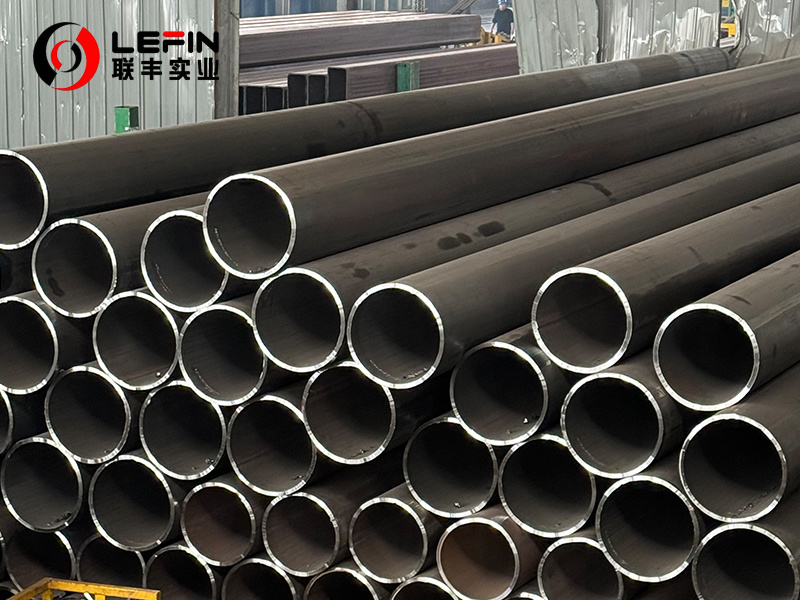


Straight Seam Welded Steel Pipe
Subcategory
Keyword
- Details
-
Introduction
Straight seam welded pipe is a type of steel pipe whose weld seam runs longitudinally along the axis of the pipe. It is made by rolling steel plates or steel strips into a tubular shape and then welding the butted edges together.
Its core feature is that the weld seam is a straight line. Compared to spiral welded pipes, straight seam welded pipes have higher dimensional accuracy and production efficiency, and they are one of the most widely used types of pipes ian fields such as oil and gas transportation, construction structures, and machinery manufacturing.The production of straight seam welded pipes mainly involves the following key steps, each of which directly affects the quality and performance of the final product:
I. Unrolling and flattening
Unroll the steel coil and pass it through the flattening machine to eliminate the curling stress, ensuring the steel plate remains flat. This is the foundation for maintaining the accuracy of subsequent forming processes.
II. Shearing and Butt Welding
Cut the steel plates as needed and connect the ends of the plates through butt welding to achieve continuous production and reduce downtime.
III. Forming (Pre-bending and Continuous Forming)
- Pre-bending: Bend the edges of the steel plate on both sides in advance to reduce the edge stretching deformation during the subsequent forming process.
- Continuous forming: The flat plate is gradually rolled into an open tube billet (commonly known as the "JCO" or "UOE" process) through multiple sets of rollers, with the deformation amount controlled to avoid stress concentration.
IV. Welding
- High-frequency Resistance Welding (ERW): Suitable for small to medium-sized pipes. It uses high-frequency current to heat the edges of the pipe billet and then applies pressure for welding. It is highly efficient and cost-effective.
- Submerged Arc Welding (SAW): This method is used for large-diameter thick-walled pipes. A flux is applied at the weld seam for double-sided welding, resulting in high strength and stable quality. Remove the internal and external welding slag immediately after welding to ensure the weld is clean.
V. Diameter Control and Straightening
The welded pipes are first adjusted radially by the diameter control machine to ensure dimensional accuracy and roundness, and then the bending deformation is eliminated by the straightening machine.
VI. Cutting and End Face Treatment
The pipe is cut to a fixed length and the pipe ends are processed with beveling or flattened to facilitate on-site connection and installation.
VII. Inspection and Corrosion Prevention
- Inspection: This includes water pressure tests, ultrasonic/eddy current inspections, X-ray examinations, etc., to ensure the sealing performance and defect-free condition of the welds.
- Preservation: Apply painting, galvanizing or coating treatment according to the application purpose to extend the service life.
Core significance
The straight seam welded pipe has high production efficiency and good dimensional accuracy, and is suitable for applications such as oil and gas transportation, construction structures, and mechanical manufacturing. Through standardized process control, it can ensure strength while reducing costs, and is one of the mainstream products for pipeline systems in modern industry.
Related products
Product Consulting
Address: Hengtai Road,Daqiuzhuang Town,Jinghai County,Tianjin,China
Mob: +8615122229899(whatspp)
Phone: +86 22 58171905
Fax: +86 22 58171902
E-mail:info@lefinsteel.com
Get company updates
Tianjin Lefin Industrial Co.,Ltd. All rights reserved City sub-station SEO www.300.cn