

-
About us
 Tianjin lefin Industrial
TIANJIN LEFIN STEEL GROUP containing Tianjin lefin Industrial Co.,Ltd. 、Tianjin lefin steel import & export Co.,Ltd and Tianjin Shengqifeng International Trading Co., Ltd. -
Products
Steel Pipe Processing
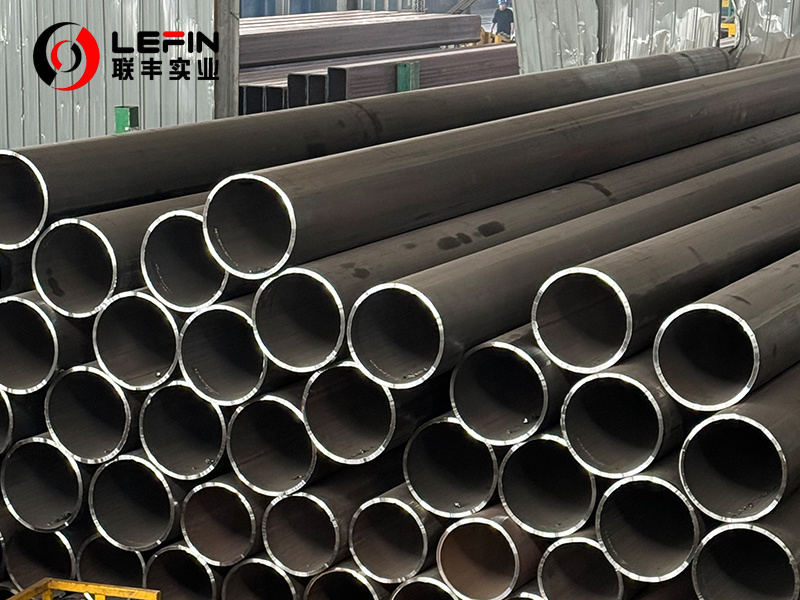
Our main products include 1/2inch to 16 inch ERW PIPE/GI PIPE which has been produced according to BS1387/ASTM A53/EN10219/EN10255/EN10217 Standard -
-
Service Capability
Guarantee Quality
Our steel pipes are suitable for oil, natural gas, shipbuilding, chemical industry, water conservancy, electrical, steel structure, construction and other related fields.
- Details
-
Our Products
Standards And Grades:ASTM A500, ASTM A501, ASTM A252 GR.A, GR.B, GR.C
EN10210, EN10219, EN 10255 S235JRH, S275J0H, S275J2H, S355J0H, S355J2H, S355NH, S460NH
JIS G3466 STKR400, STKR490
AS/NZS 1163 C250, C250LO, C350, C350LO, C450, C450LO
GB/T 3091, GB/T 6728 Q235B, Q355B, Q420B, Q460B, Q550B, Q690B
OD:(SHS)20*20-1200*1200mm WT: 1.3mm-50mm
OD:(RHS)20*30-1200*1500mm WT:1.2-50mm
OD:(CHS)20-660mm WT:1.3-16mm
Length:4m, 6m, 12m or as your requiredBrand:LEFIN STEEL
Chemical Composition
Chemical composition(cast analysis)%
Steel Grade
C
Si
max.Mn
P
max.S
max.P195GH
≤0.13
0.35
≤0.70
0.025
0.020
P235GH
≤0.16
0.35
≤1.20
0.025
0.020
P265GH
≤0.20
0.40
≤1.40
0.025
0.020
Physical Requirements
Mechanical properties for wall thickness T≤16
Steel Grade
Tensile properties at room temperature
Upper yield strength MPa
Tensile strength Mpa
Elongation %
longitudinal
transverse
P195GH
195
320-440
27
25
P235GH
235
360-500
25
23
P265GH
265
410-570
23
21
Material and Process Characteristics
1. Material characteristics:
• Non-alloy steel: based on high-strength steel, excellent pressure resistance, suitable for normal temperature fluid transport (such as oil, natural gas).
• Stainless steel: austenitic or duplex stainless steel material, strong corrosion resistance, suitable for chemical, food processing and other corrosive environment.
2. Manufacturing process:
• Welded steel pipe adopts electric welding or submerged arc welding process, and the surface coating can enhance corrosion resistance.
• Seamless steel pipe is made by perforating process, no welds, overall strength is higher, suitable for high pressure scenarios.
Core Performance Advantages
1. Mechanical properties:
• High compressive strength: seamless steel pipes can withstand extreme pressure (such as oil pipelines).
• Impact resistance: TR2 steel pipe needs to pass impact test to ensure reliability in low temperature environment.
2. Corrosion resistance:
• Stainless steel welded pipe surface treatment (such as galvanizing or passivation) to extend the service life.
3. Dimensional accuracy:
• Seamless steel pipe inner and outer walls smooth, strict tolerance control, reduce fluid resistance.
Typical Application Areas
1. The energy sector:
• Transport oil, gas and water vapor (e.g. heat exchangers, boiler pipes).
2. Chemical and Pharmaceutical Industries:
• Corrosion-resistant stainless steel tube for acid-base medium transmission.
3. Construction and machinery:
• As structural support parts or mechanical parts (such as automotive, Marine parts).
4. Extreme environments:
• Pressure equipment under high or low temperature conditions (e.g. EN10217-2 and EN10217-7 application scenarios).
Selection and Purchasing Suggestions
• Material matching: Select non-alloy steel, alloy steel or stainless steel according to the use environment (temperature, corrosion).
• Standard update: Pay attention to standard version iterations (e.g. EN10217-1:2019 instead of 2002) to ensure compliance with the latest specifications.
Attachment: Comparison with Other Standards
• The difference with EN10219: EN10219 is mainly for cold-formed welded steel pipes, while EN10217 emphasizes welded pipes for pressure applications.
• Compared with ASTM standards: EN10217 pays more attention to the requirements of environmental protection and safety of materials in the European market, and some parameters are stricter than ASTM standards.

EN10217 HOLLOW SECTIONS
Subcategory
Keyword
- Details
-
Our Products
Standards And Grades:ASTM A500, ASTM A501, ASTM A252 GR.A, GR.B, GR.C
EN10210, EN10219, EN 10255 S235JRH, S275J0H, S275J2H, S355J0H, S355J2H, S355NH, S460NH
JIS G3466 STKR400, STKR490
AS/NZS 1163 C250, C250LO, C350, C350LO, C450, C450LO
GB/T 3091, GB/T 6728 Q235B, Q355B, Q420B, Q460B, Q550B, Q690B
OD:(SHS)20*20-1200*1200mm WT: 1.3mm-50mm
OD:(RHS)20*30-1200*1500mm WT:1.2-50mm
OD:(CHS)20-660mm WT:1.3-16mm
Length:4m, 6m, 12m or as your requiredBrand:LEFIN STEEL
Chemical Composition
Chemical composition(cast analysis)%
Steel Grade
C
Si
max.Mn
P
max.S
max.P195GH
≤0.13
0.35
≤0.70
0.025
0.020
P235GH
≤0.16
0.35
≤1.20
0.025
0.020
P265GH
≤0.20
0.40
≤1.40
0.025
0.020
Physical Requirements
Mechanical properties for wall thickness T≤16
Steel Grade
Tensile properties at room temperature
Upper yield strength MPa
Tensile strength Mpa
Elongation %
longitudinal
transverse
P195GH
195
320-440
27
25
P235GH
235
360-500
25
23
P265GH
265
410-570
23
21
Material and Process Characteristics
1. Material characteristics:
• Non-alloy steel: based on high-strength steel, excellent pressure resistance, suitable for normal temperature fluid transport (such as oil, natural gas).
• Stainless steel: austenitic or duplex stainless steel material, strong corrosion resistance, suitable for chemical, food processing and other corrosive environment.
2. Manufacturing process:
• Welded steel pipe adopts electric welding or submerged arc welding process, and the surface coating can enhance corrosion resistance.
• Seamless steel pipe is made by perforating process, no welds, overall strength is higher, suitable for high pressure scenarios.
Core Performance Advantages
1. Mechanical properties:
• High compressive strength: seamless steel pipes can withstand extreme pressure (such as oil pipelines).
• Impact resistance: TR2 steel pipe needs to pass impact test to ensure reliability in low temperature environment.
2. Corrosion resistance:
• Stainless steel welded pipe surface treatment (such as galvanizing or passivation) to extend the service life.
3. Dimensional accuracy:
• Seamless steel pipe inner and outer walls smooth, strict tolerance control, reduce fluid resistance.
Typical Application Areas
1. The energy sector:
• Transport oil, gas and water vapor (e.g. heat exchangers, boiler pipes).
2. Chemical and Pharmaceutical Industries:
• Corrosion-resistant stainless steel tube for acid-base medium transmission.
3. Construction and machinery:
• As structural support parts or mechanical parts (such as automotive, Marine parts).
4. Extreme environments:
• Pressure equipment under high or low temperature conditions (e.g. EN10217-2 and EN10217-7 application scenarios).
Selection and Purchasing Suggestions
• Material matching: Select non-alloy steel, alloy steel or stainless steel according to the use environment (temperature, corrosion).
• Standard update: Pay attention to standard version iterations (e.g. EN10217-1:2019 instead of 2002) to ensure compliance with the latest specifications.
Attachment: Comparison with Other Standards
• The difference with EN10219: EN10219 is mainly for cold-formed welded steel pipes, while EN10217 emphasizes welded pipes for pressure applications.
• Compared with ASTM standards: EN10217 pays more attention to the requirements of environmental protection and safety of materials in the European market, and some parameters are stricter than ASTM standards.
Related products
Product Consulting
Address: Hengtai Road,Daqiuzhuang Town,Jinghai County,Tianjin,China
Mob: +8615122229899(whatspp)
Phone: +86 22 58171905
Fax: +86 22 58171902
E-mail:info@lefinsteel.com
Get company updates
Tianjin Lefin Industrial Co.,Ltd. All rights reserved City sub-station SEO www.300.cn