

-
About us
 Tianjin lefin Industrial
TIANJIN LEFIN STEEL GROUP containing Tianjin lefin Industrial Co.,Ltd. 、Tianjin lefin steel import & export Co.,Ltd and Tianjin Shengqifeng International Trading Co., Ltd. -
Products
Steel Pipe Processing
Our main products include 1/2inch to 16 inch ERW PIPE/GI PIPE which has been produced according to BS1387/ASTM A53/EN10219/EN10255/EN10217 Standard -
-
Service Capability
Guarantee Quality
Our steel pipes are suitable for oil, natural gas, shipbuilding, chemical industry, water conservancy, electrical, steel structure, construction and other related fields.

Our main products include 1/2inch to 16 inch ERW PIPE/GI PIPE which has been produced according to BS1387/ASTM A53/EN10219/EN10255/EN10217 Standard
Our main products include 1/2inch to 16 inch ERW PIPE/GI PIPE which has been produced according to BS1387/ASTM A53/EN10219/EN10255/EN10217 Standard
Has rich experience in steel pipe processing, can be customized according to customer requirements according to the drawing and sample processing, assist in the development of new products.
Tanzania EN 10210 S355J2H Carbon Steel Pipe
Category:
Product Description
Standard And Material Specification
Standard: EN 10210
A European standard specifying the technical delivery conditions for hot-finished hollow structural sections (HSS) made of non-alloy and fine-grain steels.
Grade: S355J2H
S355: Indicates minimum yield strength of 355 MPa at room temperature.
J2: Charpy V-notch impact toughness requirement at -20°C (27 Joules minimum).
H: Denotes hot-finished production (as opposed to cold-formed).
Chemical Properties
| Steel Grade | C Maximum | Mn Maximum | Si Maximum | P Maximum | S Maximum | N Maximum |
| S235JRH | 0.17 | 1.40 | – | 0.040 | 0.040 | 0.009 |
| S355J0H | 0.22 | 1.60 | 0.55 | 0.035 | 0.035 | 0.009 |
| S275J2H | 0.20 | 1.50 | – | 0.030 | 0.030 | – |
| S355J2H | 0.22 | 1.60 | 0.55 | 0.030 | 0.030 | – |
| S275J0H | 0.20 | 1.50 | – | 0.035 | 0.035 | 0.009 |
| S355K2H | 0.22 | 1.60 | 0.55 | 0.030 | 0.030 | – |
Carbon (C) – Enhances hardness and strength but reduces ductility and weldability (controlled to ≤0.22% for balance).
Silicon (Si) – Improves strength and deoxidation during steelmaking (limited to ≤0.55% to avoid brittleness).
Manganese (Mn) – Increases strength and hardenability while improving hot workability (≤1.6%).
Phosphorus (P) & Sulfur (S) – Harmful impurities (≤0.030% each); reduce toughness and promote cracking.
Key Impact: Elements are balanced to achieve optimal mechanical properties (strength, weldability, impact resistance) for structural applications.
Mechanical Properties
EN 10210 | Mechanical Strength | Impact Energy | ||||
Yield Strength (WT≤16mm) | Elongation (%) (WT≤40mm) | Tensile Strength (WT≤3mm) | Test Temperature in celsius | |||
| -20 | 0 | 20 | ||||
| S355J2H | 355 | 22 | 510-680 | 27 | – | – |
| S275J0H | 275 | 23 | 430-580 | – | 27 | – |
| S275J2H | 275 | 23 | 430-580 | 27 | – | – |
| S235JRH | 235 | 26 | 360-510 | – | – | 27 |
| S355J0H | 355 | 22 | 510-680 | – | 27 | – |
| S355K2H | 355 | 22 | 510-680 | 40 | – | – |
Yield Strength (≥355 MPa) – Indicates the stress at which permanent deformation begins; ensures structural stability under load.
Tensile Strength (510–680 MPa) – Measures maximum stress before failure; guarantees resistance to breaking under tension.
Elongation (≥22%) – Reflects ductility; higher values mean better formability and crack resistance.
Charpy Impact (≥27 J at -20°C) – Evaluates toughness in cold environments; critical for shock/fracture resistance.
Key Impact: These properties ensure the pipe can withstand heavy loads, dynamic forces, and low temperatures without failure.
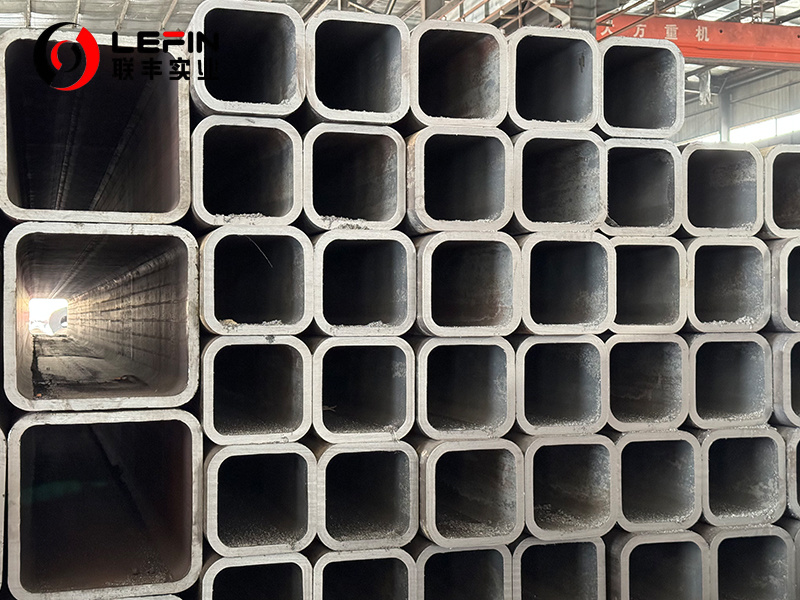
Manufacturing Process
Raw Material Preparation: High-quality steel slabs or billets with the specified chemical composition for S355J2H are selected.
Heating: The steel is heated to around 1100–1200°C to make it ductile for shaping.
Rolling: The heated steel is rolled through specialized mills to form the rectangular hollow sections, ensuring precise dimensions and uniform wall thickness.
Cooling and Straightening: The pipe is cooled gradually to avoid internal stresses and then straightened if necessary.
Inspection and Testing: The finished pipe undergoes dimensional checks, non-destructive testing (e.g., ultrasonic), and mechanical property tests to ensure compliance with EN 10210 standards.
Surface Treatment (Optional): The pipe may be painted or galvanized to enhance corrosion resistance.
Packaging and Storage: The pipes are packaged and stored for shipment.
Applications
Structural Engineering: Building frames, bridges, and offshore platforms.
Mechanical Components: Heavy machinery, load-bearing parts.
Infrastructure: Pipelines, support columns, and crane booms.
Advantages
High Strength-to-Weight Ratio: Suitable for heavy-load applications.
Good Weldability: Preheating may be required for thick sections.
Impact Resistance: Reliable performance in low-temperature environments.
In summary, EN 10210 S355J2H is a high-strength carbon steel pipe offering excellent mechanical properties and impact resistance. Its hot-finished production ensures superior quality for structural applications in construction, machinery, and infrastructure. With certified performance and cost efficiency, it's a reliable choice for demanding engineering projects.
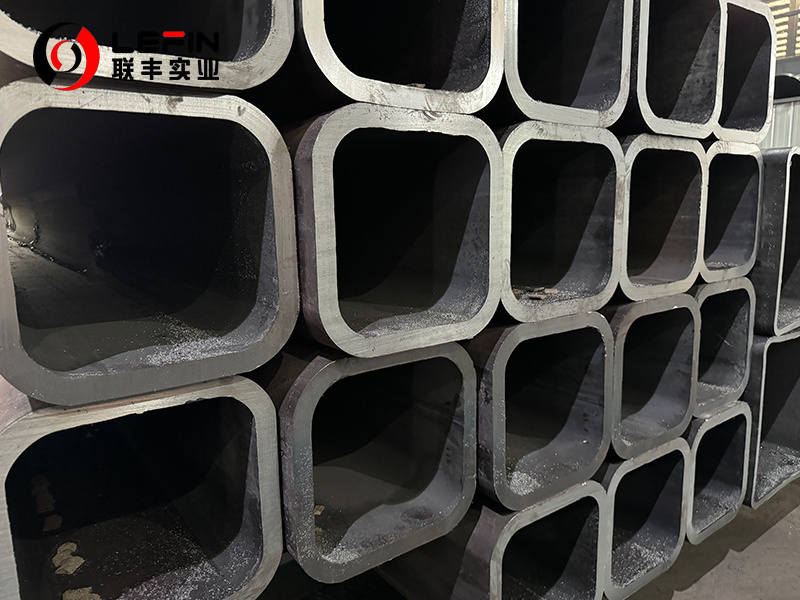


Address: Hengtai Road,Daqiuzhuang Town,Jinghai County,Tianjin,China
Mob: +8615122229899(whatspp)
Phone: +86 22 58171905
Fax: +86 22 58171902
E-mail:info@lefinsteel.com
Get company updates
Tianjin Lefin Industrial Co.,Ltd. All rights reserved City sub-station SEO www.300.cn