

-
About us
 Tianjin lefin Industrial
TIANJIN LEFIN STEEL GROUP containing Tianjin lefin Industrial Co.,Ltd. 、Tianjin lefin steel import & export Co.,Ltd and Tianjin Shengqifeng International Trading Co., Ltd. -
Products
Steel Pipe Processing
Our main products include 1/2inch to 16 inch ERW PIPE/GI PIPE which has been produced according to BS1387/ASTM A53/EN10219/EN10255/EN10217 Standard -
-
Service Capability
Guarantee Quality
Our steel pipes are suitable for oil, natural gas, shipbuilding, chemical industry, water conservancy, electrical, steel structure, construction and other related fields.

Our main products include 1/2inch to 16 inch ERW PIPE/GI PIPE which has been produced according to BS1387/ASTM A53/EN10219/EN10255/EN10217 Standard
Our main products include 1/2inch to 16 inch ERW PIPE/GI PIPE which has been produced according to BS1387/ASTM A53/EN10219/EN10255/EN10217 Standard
Has rich experience in steel pipe processing, can be customized according to customer requirements according to the drawing and sample processing, assist in the development of new products.
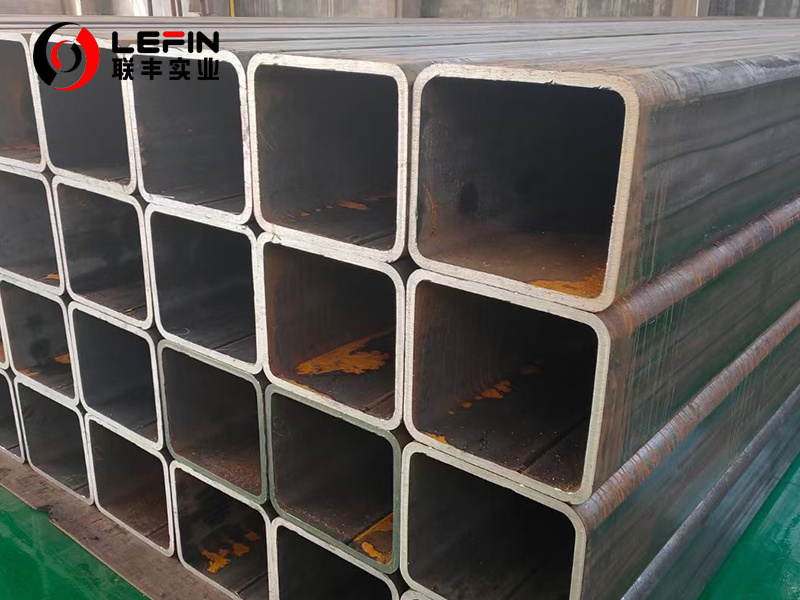
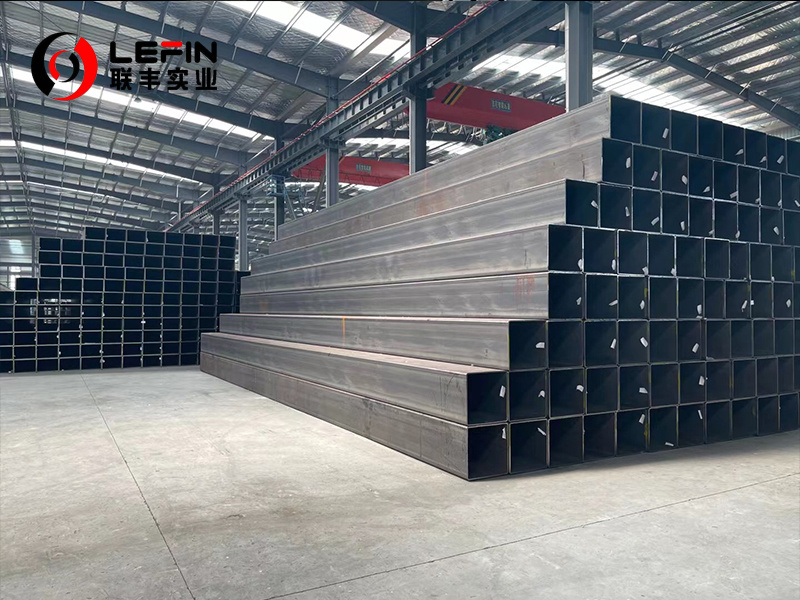
Slovakia EN 10219 S235JRH Structural Steel Pipes
Category:
Product Description
Governing Standard
EN 10219: This European Standard specifies the technical delivery conditions for cold-formed welded structural hollow sections (circular, square, or rectangular pipes/tubes) made of non-alloy and fine grain steels. It covers:
Part 1: Technical delivery conditions (EN 10219-1)
Part 2: Tolerances, dimensions, and sectional properties (EN 10219-2)
Material Grade: S235JRH
S: Stands for "Structural Steel".
235: Indicates the specified minimum Yield Strength (ReH) at room temperature is 235 Megapascals (MPa) or N/mm². This is the stress at which the steel begins to deform plastically (permanently).
JR: Denotes the Impact Energy (Toughness) requirement:
J: Specifies that the Charpy V-notch impact test is required.
R: Specifies the test temperature is +20°C (Room Temperature). The material must achieve a minimum average impact energy of 27 Joules (J) longitudinally for the specified test pieces.
H: Specifically indicates the steel is intended for the manufacture of Hollow Sections according to EN 10210 (hot-finished) or EN 10219 (cold-formed). This implies certain chemical composition adjustments optimized for the hollow section manufacturing process.
Mechanical Properties
The mechanical properties of EN 10219 S235JRH structural steel tubes can be verified using tensile and impact tests.
Tensile Requirement
The tensile test shall be carried out in the temperature range of 10 °C – 35 °C, in accordance with the experimental requirements of EN 10002-1.
| Mechanical properties of non-alloy steel hollow sections | |||||
| Steel designation | Yield strength, | Tensle strength, | Elongation Ac,min,% | ||
| min,psi [MPa] | min,psi[MPa] | ||||
| Nominal thickness | Nominal thickness | Nominal thickness | |||
| ≤ 16 | > 16 ≤ 40 | <3 | ≥3≤40 | ≤ 40 | |
| S235JRHa | 235 | 225 | 360-510 | 340-470 | 24b |
a The impact properties are verified only when Option 1.3 is specified.
b For thicknesses > 3 mm and section sizes D/T < 15 (round) and (B+H)/2T < 12.5 (square and rectangular) the minimum elongation is reduced by 2. For thicknesses < 3 mm the minimum value for elongation is 17 %.
c For thicknesses < 3 mm see 9.2.2.
Impact Requirement
The impact test shall comply with the requirements of EN 10045-1.
However, S235JRH quality tubes do not need to be individually verified unless there are specific requirements.
| Steel name | Minimum impact energy KV e, J |
| at test temperature of | |
| 20 ℃ | |
| S235JRH | 27 |
e For impact properties for reduced section test pieces see 6.7.2.
Chemical Components
EN 10219 S235JRH has a maximum carbon content of 0.17 % and is classified as a non-alloy steel, also known as a carbon steel pipe.
| Steel grade | Type of deoxidation a | % by mass, maximum | |||||
| C | Si | Mn | P | S | N b | ||
| Specified thickness (mm) | |||||||
| ≤40 | |||||||
| S235JRH | FF | 0.17 | - | 1.40 | 0.040 | 0.040 | 0.009 |
a The deoxidation methods are designated as follows:
FF =Fully killed steel containing nitrogen-binding elements in amounts sufficient to bind available nitrogen.
(e.g. min 0.020 % total Al, or 0.015 % soluble Al).
b The maximum value for nitrogen does not apply if the chemical composition shows a minimum total Al content of 0.020 %with a minimum Al/N ratio of 2:1, or if sufficient other N-binding elements are present. The N-binding elements shall be recorded in the inspection Document.
EN 10219 S235JRH The maximum permissible carbon equivalent value (CEV) is 0.35%.
The EN 10219 CEV calculation formula is: CEV = C + Mn/6 + (Cr + Mo + V)/5 + (Ni + Cu)/15
Manufacturing Process
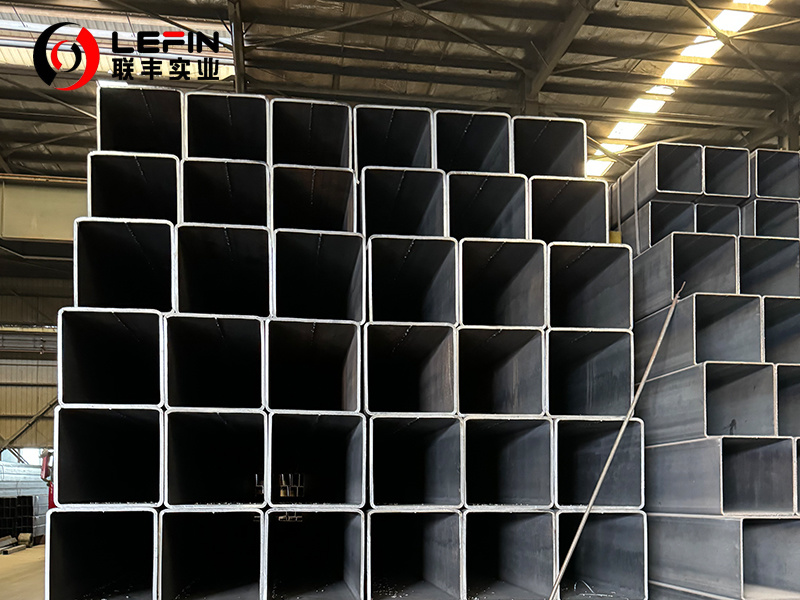
Cold-Formed Welded: The pipe is manufactured by cold-forming steel strip/sheet/plate into the desired circular, square, or rectangular shape and then welding the seam (usually using high-frequency induction welding (HFI) or submerged arc welding (SAW)). The cold-forming process increases strength slightly but may reduce ductility compared to hot-finished sections.
Non-Alloy Steel: S235JRH is classified as a non-alloy steel under this standard.
Delivery Condition: Typically supplied in the "as-welded" (+A) condition. Further processing like cold-drawing or heat treatment (normalizing) might be possible but requires specification and agreement.
Dimensions & Tolerances
Governed by EN 10219-2. This standard defines:
Outside dimensions (diameter for round, width/height for rectangular/square).
Wall thickness.
Cross-sectional properties (cross-sectional area, moment of inertia, section modulus, etc.).
Permissible tolerances on straightness, squareness, outside dimensions, wall thickness, mass, and weld seam properties.
| Characteristics | Tolerances | |
| Outside dimensions of side | (H,B<100mm) | ±1%with a min of±0.5mm |
| H:Longest side B:Shortest side | (100mm≤H,B≤200mm) (200mm | ±0.8% ±0.6% |
| Wall thickness(T) | (T≤5mm) | ±10% |
| (5mm | ±0.50mm | |
| Concavity /Convexity | MAX 0.8%with a min of 0.5mm | |
| Squareness of sides | 90°±1° | |
| External corner radius | (T≤6mm) | 1.6T≤R≤2.4T |
| (6mm | 2.0T≤R≤3.0T | |
| (10mm | 2.4T≤R≤3.6T | |
| Twist | 2mm+0.5mm/m in length | |
| Straightness | 0.15% in total length | |
| Mass | ±6% in individual lengths | |
| Length Approximate | 0,+50mm | |
| Exact L<6,000mm 6,000mm≤L≤10,000mm 10,000mm | 0,+5mm | |
| 0,+15mm | ||
| 0,+5mm+1mm/m | ||
| NOTE 1)The outside dimensions are measured across the flats at positions at least 50mm from the end of the HSS. | ||

Primary Applications
Structural Engineering: Widely used in construction for load-bearing elements where good weldability and moderate strength are sufficient. Common examples include:
Building frames (columns, beams, trusses, bracing)
Stadiums and roof structures
Bridges (secondary elements, parapets, bracing)
Support structures (towers, gantries, platforms)
Architectural applications (handrails, facades - often requiring surface treatment)
Machinery frames
Note: Not intended for pressure containment applications.
Key Advantages
Good strength-to-weight ratio.
Excellent weldability and cold-forming properties.
Consistent quality and dimensional accuracy due to standardized manufacturing.
Availability in various shapes (round, square, rectangular) and sizes.
Relatively good ductility and impact toughness at room temperature (JR grade).
Summary
EN 10219 S235JRH designates a cold-formed welded structural steel hollow section (pipe or tube) manufactured to the European standard EN 10219. It is made from a non-alloy steel with a minimum yield strength of 235 MPa. The "JRH" suffix specifies that it has verified impact toughness (≥27J average) at room temperature (+20°C) and is specifically produced for hollow section applications. It offers good mechanical properties, weldability, and formability, making it a common and versatile choice for structural frameworks in construction and engineering. Dimensions and tolerances are strictly controlled by EN 10219-2.
Address: Hengtai Road,Daqiuzhuang Town,Jinghai County,Tianjin,China
Mob: +8615122229899(whatspp)
Phone: +86 22 58171905
Fax: +86 22 58171902
E-mail:info@lefinsteel.com
Get company updates
Tianjin Lefin Industrial Co.,Ltd. All rights reserved City sub-station SEO www.300.cn