

-
About us
 Tianjin lefin Industrial
TIANJIN LEFIN STEEL GROUP containing Tianjin lefin Industrial Co.,Ltd. 、Tianjin lefin steel import & export Co.,Ltd and Tianjin Shengqifeng International Trading Co., Ltd. -
Products
Steel Pipe Processing
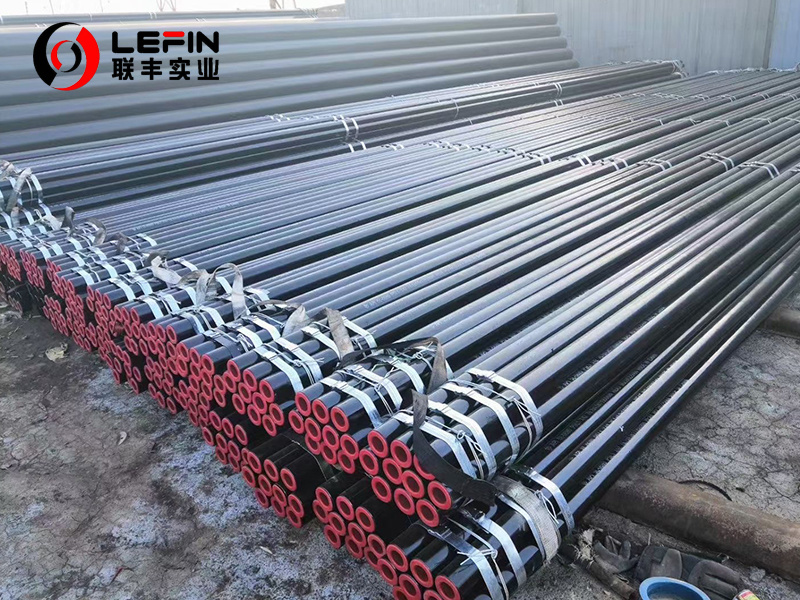
Our main products include 1/2inch to 16 inch ERW PIPE/GI PIPE which has been produced according to BS1387/ASTM A53/EN10219/EN10255/EN10217 Standard -
-
Service Capability
Guarantee Quality
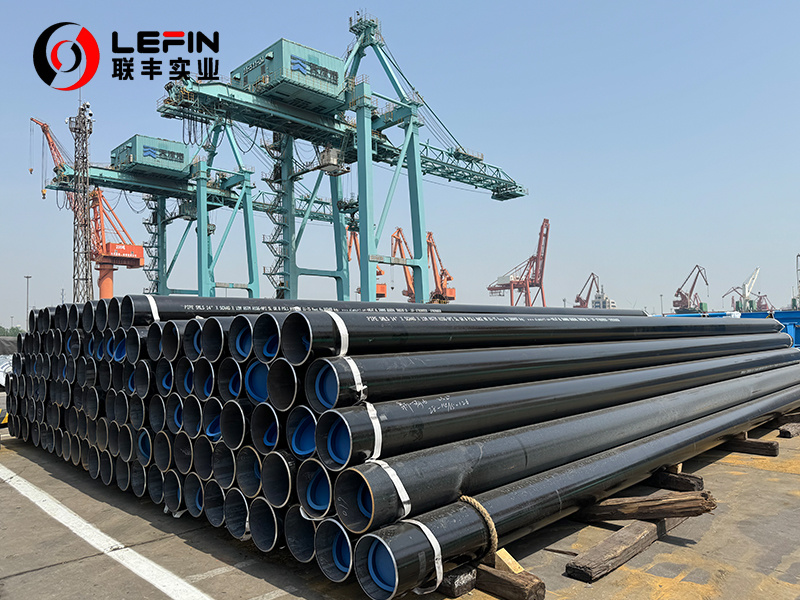
Our steel pipes are suitable for oil, natural gas, shipbuilding, chemical industry, water conservancy, electrical, steel structure, construction and other related fields.

Our main products include 1/2inch to 16 inch ERW PIPE/GI PIPE which has been produced according to BS1387/ASTM A53/EN10219/EN10255/EN10217 Standard
Our main products include 1/2inch to 16 inch ERW PIPE/GI PIPE which has been produced according to BS1387/ASTM A53/EN10219/EN10255/EN10217 Standard
Has rich experience in steel pipe processing, can be customized according to customer requirements according to the drawing and sample processing, assist in the development of new products.
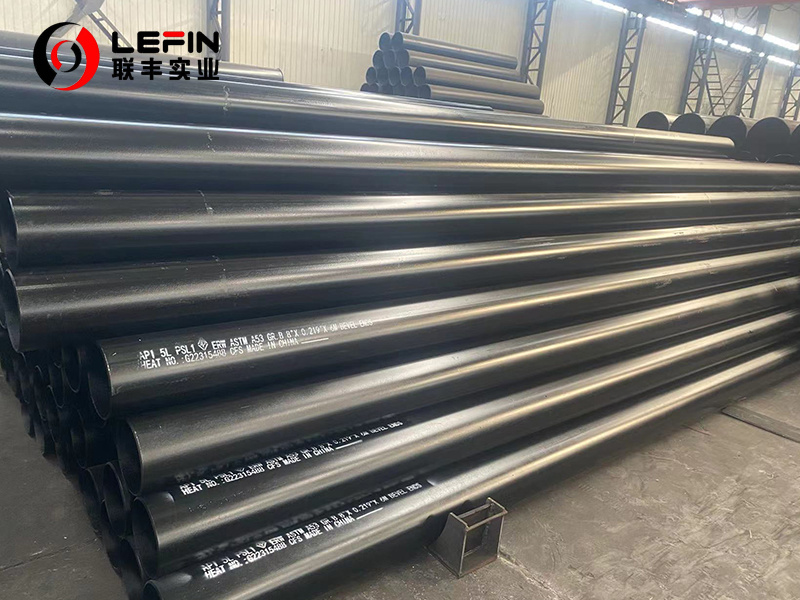
Sierra Leone API 5L PSL1 Pipe
Category:
Product Description
Overview
API 5L (American Petroleum Institute Specification 5L) is a widely recognized standard for line pipe used in the transportation of gas, water, and oil in the petroleum and natural gas industries. PLS1 (Product Specification Level 1) is one of the three product specification levels defined in API 5L, with PSL 1 representing the basic level of requirements for standard pipeline applications.
PSL1: This level provides a standard quality baseline for line pipes. It sets the basic requirements for material properties and testing. PSL1 pipes are suitable for general pipeline applications.
Manufacturing Process
Materials: The raw materials used for manufacturing API 5L PSL1 pipes include ingots, blooms, billets, coils, or plates. These materials are typically produced through basic oxygen, electric furnace, or open hearth processes, combined with ladle refining.
Types of Pipes: PSL1 pipes can be either seamless or welded. Seamless pipes are produced through hot rolling or extrusion processes, while welded pipes can be manufactured using methods such as Electric Resistance Welding (ERW) or Submerged Arc Welding (SAW).
Chemical Composition
The chemical composition of API 5L PSL1 pipes varies depending on the grade but generally includes the following elements:
Chemical Composition for PSL 1 Pipe with t ≤ 25.0 mm (0.984 in.) | ||||||||
|---|---|---|---|---|---|---|---|---|
Steel Grade | Mass Fraction, Based on Heat and Product Analyses a,g | |||||||
C | Mn | P | S | V | Nb | Ti | ||
max b | max b | min | max | max | max | max | max | |
| Seamless Pipe | ||||||||
| L175 or A25 | 0.21 | 0.60 | - | 0.030 | 0.030 | - | - | - |
| L175P or A25P | 0.21 | 0.60 | 0.045 | 0.080 | 0.030 | - | - | - |
| L210 or A | 0.22 | 0.90 | - | 0.030 | 0.030 | - | - | - |
| L245 or B | 0.28 | 1.20 | - | 0.030 | 0.030 | c,d | c,d | d |
| L290 or X42 | 0.28 | 1.30 | - | 0.030 | 0.030 | d | d | d |
| L320 or X46 | 0.28 | 1.40 | - | 0.030 | 0.030 | d | d | d |
| L360 or X52 | 0.28 | 1.40 | - | 0.030 | 0.030 | d | d | d |
| L390 or X56 | 0.28 | 1.40 | - | 0.030 | 0.030 | d | d | d |
| L415 or X60 | 0.28 e | 1.40 e | - | 0.030 | 0.030 | f | f | f |
| L450 or X65 | 0.28 e | 1.40 e | - | 0.030 | 0.030 | f | f | f |
| L485 or X70 | 0.28 e | 1.40 e | - | 0.030 | 0.030 | f | f | f |
| Welded Pipe | ||||||||
| L175 or A25 | 0.21 | 0.60 | - | 0.030 | 0.030 | - | - | - |
| L175P or A25P | 0.21 | 0.60 | 0.045 | 0.080 | 0.030 | - | - | - |
| L210 or A | 0.22 | 0.90 | - | 0.030 | 0.030 | - | - | - |
| L245 or B | 0.26 | 1.20 | - | 0.030 | 0.030 | c,d | c,d | d |
| L290 or X42 | 0.26 | 1.30 | - | 0.030 | 0.030 | d | d | d |
| L320 or X46 | 0.26 | 1.40 | - | 0.030 | 0.030 | d | d | d |
| L360 or X52 | 0.26 | 1.40 | - | 0.030 | 0.030 | d | d | d |
| L390 or X56 | 0.26 | 1.40 | - | 0.030 | 0.030 | d | d | d |
| L415 or X60 | 0.26 e | 1.40 e | - | 0.030 | 0.030 | f | f | f |
| L450 or X65 | 0.26 e | 1.45 e | - | 0.030 | 0.030 | f | f | f |
| L485 or X70 | 0.26 e | 1.65 e | - | 0.030 | 0.030 | f | f | f |
a. Cu ≤ 0.50 %; Ni ≤ 0.50 %; Cr ≤ 0.50 % and Mo ≤ 0.15 %. b. For each reduction of 0.01 % below the specified maximum concentration for carbon, an increase of 0.05 % above the specified maximum concentration for Mn is permissible, up to a maximum of 1.65 % for grades ≥ L245 or B, but ≤ L360 or X52; up to a maximum of 1.75 % for grades > L360 or X52, but < L485 or X70; and up to a maximum of 2.00 % for Grade L485 or X70. c. Unless otherwise agreed, Nb + V ≤ 0.06 %. d. Nb + V + Ti ≤ 0. 15 %. e. Unless otherwise agreed. f. Unless otherwise agreed, Nb + V + Ti ≤ 0. 15 %. g. No deliberate addition of B is permitted and the residual B ≤ 0.001 %. | ||||||||
PSL1 has less stringent requirements compared to PSL2, with no mandatory limits on carbon equivalent (CE) or microalloying elements unless specified by the purchaser.

Mechanical Properties
Requirements for the Results of Tensile Tests for PSL 1 Pipe | ||||
|---|---|---|---|---|
Pipe Grade | Pipe Body of Seamless and Welded Pipe | Weld Seam of EW, | ||
Yield Strength a Rt0.5 | Tensile Strength a Rm | Elongation | Tensile Strength Rm | |
min | min | min | min | |
| L175 or A25 | 175 (25,400) | 310 (45,000) | c | 310 (45,000) |
| L175P or A25P | 175 (25,400) | 310 (45,000) | c | 310 (45,000) |
| L210 or A | 210 (30,500) | 335 (48,600) | c | 335 (48,600) |
| L245 or B | 245 (35,500) | 415 (60,200) | c | 415 (60,200) |
| L290 or X42 | 290 (42,100) | 415 (60,200) | c | 415 (60,200) |
| L320 or X46 | 320 (46,400) | 435 (63,100) | c | 435 (63,100) |
| L360 or X52 | 360 (52,200) | 460 (66,700) | c | 460 (66,700) |
| L390 or X56 | 390 (56,600) | 490 (71,100) | c | 490 (71,100) |
| L415 or X60 | 415 (60,200) | 520 (75,400) | c | 520 (75,400) |
| L450 or X65 | 450 (65,300) | 535 (77,600) | c | 535 (77,600) |
| L485 or X70 | 485 (70,300) | 570 (82,700) | c | 570 (82,700) |
a For intermediate grades, the difference between the specified minimum tensile strength and the specified minimum yield strength for the pipe body shall be as given in the table for the next higher grade. b For intermediate grades, the specified minimum tensile strength for the weld seam shall be the same value as was determined for the pipe body using footnote a). c The specified minimum elongation, Af, expressed in percent and rounded to the nearest percent, shall be as determined using the following equation: where C is 1940 for calculations using SI units and 625,000 for calculations using USC units Axc is the applicable tensile test piece cross-sectional area, expressed in square millimeters (square inches), as follows: 1) for circular cross-section test pieces, 130 mm2 (0.20 in.2) for 12.7 mm (0.500 in.) and 8.9 mm (0.350 in.) diameter test pieces; 65 mm2 (0. 10 in.2) for 6.4 mm (0.250 in.) diameter test pieces; 2) for full-section test pieces, the lesser of a) 485 mm2 (0.75 in.2) and b) the cross-sectional area of the test piece, derived using the specified outside diameter and the specified wall thickness of the pipe, rounded to the nearest 10 mm2 (0.01 in.2); 3) for strip test pieces, the lesser of a) 485 mm2 (0.75 in.2) and b) the cross-sectional area of the test piece, derived using the specified width of the test piece and the specified wall thickness of the pipe, rounded to the nearest 10 mm2 (0.01 in.2); U is the specified minimum tensile strength, expressed in megapascals (pounds per square inch). | ||||


Tensile strength, yield strength, and elongation are tested but with fewer restrictions than PSL2.
Charpy impact testing is not mandatory unless specified for low-temperature applications.
Testing & Inspection
Hydrostatic Testing: Mandatory for all PSL1 pipes.
Non-Destructive Testing (NDT):
Welded Pipes: For welded pipes with an outer diameter greater than or equal to 2.375 inches (60.3 mm), 100% NDT is required. Methods include magnetic particle inspection, liquid penetrant inspection, radiographic testing, and ultrasonic testing.
Seamless Pipes: NDT requirements may vary based on the specific grade and manufacturing process.
End Finish And Surface Treatments
End Finish
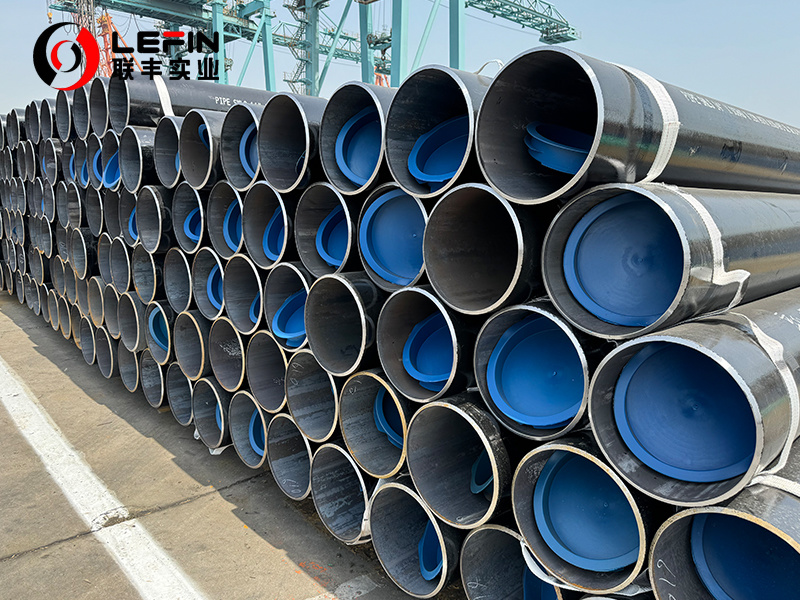
API 5L PSL1 pipes can have plain ends or beveled ends, depending on the application requirements.
Coatings And Surface Treatments
Surface: Options include bare, black, lightly oiled, hot-dip galvanized, varnish coating/anti-rust oil, or protective coatings.
Coatings: For corrosion protection, pipes may be coated with materials such as three-layer polyethylene (3PE).
Applications And Advantages
Applications
Low-to-medium pressure oil & gas pipelines
Water transmission systems
Structural and general-purpose piping (where high toughness is not critical)
Advantages
Lower cost due to simpler production and testing requirements.
Suitable for non-critical environments where high toughness is unnecessary.
Summary
API 5L PSL1 pipes are widely used in the oil and gas industry for their reliability and standard quality. They are available in a variety of sizes, grades, and delivery conditions to meet different pipeline requirements. The manufacturing process, chemical composition, and mechanical properties are strictly regulated to ensure performance and safety in service.
Address: Hengtai Road,Daqiuzhuang Town,Jinghai County,Tianjin,China
Mob: +8615122229899(whatspp)
Phone: +86 22 58171905
Fax: +86 22 58171902
E-mail:info@lefinsteel.com
Get company updates
Tianjin Lefin Industrial Co.,Ltd. All rights reserved City sub-station SEO www.300.cn