

-
About us
 Tianjin lefin Industrial
TIANJIN LEFIN STEEL GROUP containing Tianjin lefin Industrial Co.,Ltd. 、Tianjin lefin steel import & export Co.,Ltd and Tianjin Shengqifeng International Trading Co., Ltd. -
Products
Steel Pipe Processing
Our main products include 1/2inch to 16 inch ERW PIPE/GI PIPE which has been produced according to BS1387/ASTM A53/EN10219/EN10255/EN10217 Standard -
-
Service Capability
Guarantee Quality
Our steel pipes are suitable for oil, natural gas, shipbuilding, chemical industry, water conservancy, electrical, steel structure, construction and other related fields.

Our main products include 1/2inch to 16 inch ERW PIPE/GI PIPE which has been produced according to BS1387/ASTM A53/EN10219/EN10255/EN10217 Standard
Our main products include 1/2inch to 16 inch ERW PIPE/GI PIPE which has been produced according to BS1387/ASTM A53/EN10219/EN10255/EN10217 Standard
Has rich experience in steel pipe processing, can be customized according to customer requirements according to the drawing and sample processing, assist in the development of new products.
PRODUCTS CENTER
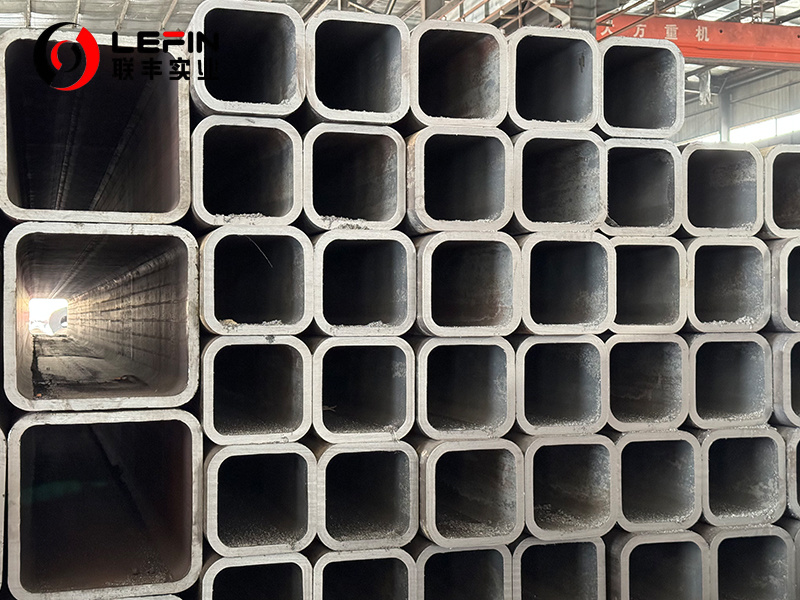
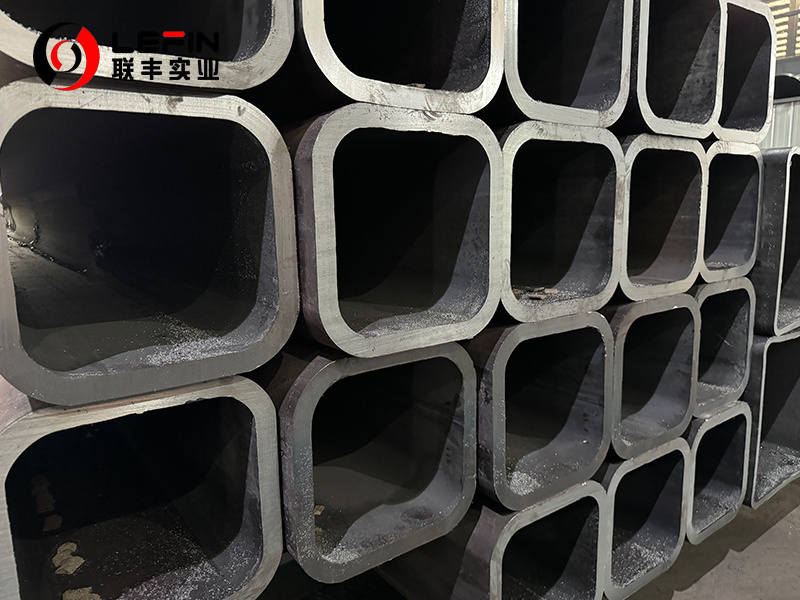
Papua New Guinea EN 10210 TUBES
Category:
Product Description
Detailed Description Of EN 10210 Tubes
EN 10210 is a European standard that specifies the technical requirements for hot-finished structural hollow sections made from non-alloy and fine-grained steels. These sections are widely used in construction, bridges, machinery, and other load-bearing structures due to their high strength, durability, and design flexibility. Below is a comprehensive overview of the standard:
Scope Of The Standard
EN 10210 applies to welded hot-finished hollow sections (produced by hot-rolling or hot-forming processes) with the following cross-sectional shapes:
Circular Hollow Sections (CHS)
Square Hollow Sections (SHS)
Rectangular Hollow Sections (RHS)
These sections are designed for structural applications where mechanical performance and resistance to dynamic or static loads are critical.
Material Grades
The standard covers steel grades based on yield strength and impact toughness, including:
S235JRH (minimum yield strength: 235 MPa)
S275J0H/S275J2H
S355J0H/S355J2H (most common for high-strength applications)
S460J0H/S460J2H (ultra-high strength for heavy-duty structures)
Key Material Properties
Chemical Composition: Strict limits on carbon (C), manganese (Mn), sulfur (S), and phosphorus (P) content.
Impact Toughness: Grades with suffixes "J2H" or "J0H" require Charpy V-notch testing at low temperatures (e.g., -20°C or -30°C).
Manufacturing Process
Hot Forming: The steel is shaped at high temperatures (900–1200°C), enhancing material uniformity and reducing residual stresses.
Welding: Longitudinal seams are welded using high-frequency induction welding (HFIW) or submerged arc welding (SAW). Welds undergo non-destructive testing (NDT) to ensure integrity.
Post-Processing: Normalizing (heat treatment) may be applied to refine the grain structure and improve mechanical properties.
Dimensions And Tolerances
Typical Size Ranges:
CHS: Outer diameter 1/2 - 24 inch, wall thickness 1.3 - 22 mm.
SHS: Side length 20 - 1200 mm, wall thickness 1.2 - 50 mm.
RHS: Longer side 30 - 1500 mm, shorter side 20 - 1000 mm, wall thickness 1.2 - 50 mm.
Tolerances: Strict limits on dimensional deviations, including outer diameter/width (±1–5%), wall thickness (±5%), straightness, and ovality.
Mechanical Properties
EN 10210 specifies the following minimum mechanical properties for standard grades:
| Steel Grade | Yield Strength (MPa) | Tensile Strength (MPa) | Elongation (%) |
|---|---|---|---|
| S235JRH | ≥235 | 360–510 | ≥24 |
| S355J2H | ≥355 | 470–630 | ≥22 |
| S460J0H | ≥460 | 550–720 | ≥17 |
Additional Requirements:
Impact Energy: For example, S355J2H requires ≥27 J at -20°C.
Hardness Testing: To prevent brittle fracture risks.
Applications And Advantages
Construction: Building frames, trusses, columns, and roof supports.
Bridges: Main girders, piers, and bracing systems.
Industrial Machinery: Crane booms, conveyor frames, and heavy equipment.
Infrastructure: Lighting poles, stadiums, and offshore platforms.
Advantages:
High torsional and bending stiffness.
Optimized weight-to-strength ratio. Smooth surfaces for easy coating or galvanizing. Products Description
Comparison With EN 10219 (Cold-Formed Hollow Sections)
| Feature | EN 10210 (Hot-Finished) | EN 10219 (Cold-Formed) |
|---|---|---|
| Manufacturing | Produced at high temperatures (900–1200°C). | Produced at room temperature. |
| Process | Hot-rolling or hot-forming; improves material uniformity. | Cold-forming; achieves higher dimensional precision. |
| Material Grades | S235JRH, S275J0H, S355J2H, S460J0H, etc. | Similar grades (e.g., S235JRH, S355J2H). |
| Mechanical Properties | Higher toughness and ductility due to hot-forming. | Slightly lower toughness; excellent dimensional accuracy. |
| Applications | Heavy-load structures (bridges, high-rise buildings). | Lightweight structures (façades, decorative frameworks). |
| Cost | Higher cost due to complex manufacturing process. | More cost-effective for lightweight applications. |
| Residual Stresses | Lower residual stresses due to high-temperature forming. | Higher residual stresses due to cold-forming. |
| Surface Finish | Smooth surfaces, suitable for heavy-duty coatings. | Very smooth surfaces, ideal for aesthetic applications. |
| Typical Use Cases | Industrial machinery, offshore platforms, heavy frames. | Light-duty supports, architectural structures. |
Surface Treatment And Corrosion Protection
Hot-Dip Galvanizing: Provides long-term corrosion resistance for outdoor use.
Painting/Powder Coating: Enhances aesthetics and durability.
Blast Cleaning: Improves adhesion of coatings.
Quality Control And Certification
Testing: Chemical analysis, tensile testing, Charpy impact tests, hardness tests, and NDT (ultrasonic or radiographic inspection of welds).
Certification: CE marking compliant with EU Construction Products Regulation (CPR).
Conclusion
EN 10210 hot-finished hollow sections are a cornerstone of modern structural engineering, offering exceptional strength, reliability, and adaptability. Engineers must select appropriate grades and geometries based on load requirements, environmental conditions, and cost considerations. Compliance with the standard ensures safety and performance in critical applications. For detailed specifications, consult the official EN 10210 documentation or collaborate with certified manufacturers.


Address: Hengtai Road,Daqiuzhuang Town,Jinghai County,Tianjin,China
Mob: +8615122229899(whatspp)
Phone: +86 22 58171905
Fax: +86 22 58171902
E-mail:info@lefinsteel.com
Get company updates
Tianjin Lefin Industrial Co.,Ltd. All rights reserved City sub-station SEO www.300.cn