

-
About us
 Tianjin lefin Industrial
TIANJIN LEFIN STEEL GROUP containing Tianjin lefin Industrial Co.,Ltd. 、Tianjin lefin steel import & export Co.,Ltd and Tianjin Shengqifeng International Trading Co., Ltd. -
Products
Steel Pipe Processing
Our main products include 1/2inch to 16 inch ERW PIPE/GI PIPE which has been produced according to BS1387/ASTM A53/EN10219/EN10255/EN10217 Standard -
-
Service Capability
Guarantee Quality
Our steel pipes are suitable for oil, natural gas, shipbuilding, chemical industry, water conservancy, electrical, steel structure, construction and other related fields.

Our main products include 1/2inch to 16 inch ERW PIPE/GI PIPE which has been produced according to BS1387/ASTM A53/EN10219/EN10255/EN10217 Standard
Our main products include 1/2inch to 16 inch ERW PIPE/GI PIPE which has been produced according to BS1387/ASTM A53/EN10219/EN10255/EN10217 Standard
Has rich experience in steel pipe processing, can be customized according to customer requirements according to the drawing and sample processing, assist in the development of new products.
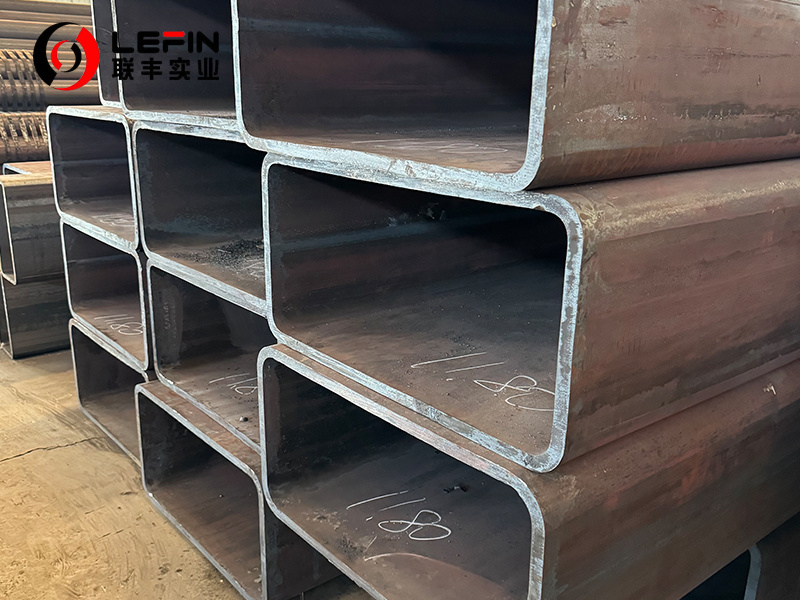
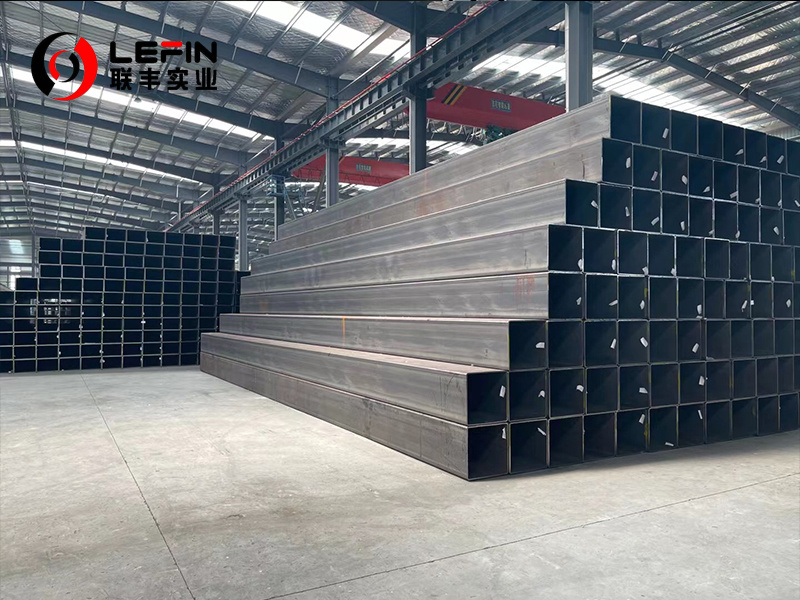
Moldova ASTM A572 GR.50 HOLLOW SECTION
Category:
Product Description
ASTM A572 Grade 50 HOLLOW SECTION
ASTM A572 Grade 50 is a high-strength structural steel with a minimum yield strength of 50 ksi (345 MPa). It is known for its good ductility and weldability, making it suitable for various construction and engineering applications.
CLICK HERE➡What Is ASTM A572 Standard
Mechanical Properties
Tensile Requirements A | ||||||
Grade | Yield Point,min | Tensile Strength,min | Minimum Elongation,% B,C,D | |||
ksi | [MPa] | ksi | [MPa] | in 8 in. | in 2 in. | |
50 [345] | 50 | [345] | 65 | [450] | 18 | 21 |
| A See specimen orientation under the Tension Tests section of Specification A6/A6M. | ||||||
| B Elongation not required to be determined for floor plate. | ||||||
| C For wideflange shapes over 426 lb/ft [634 kg/m],elongation in 2 in.[50 mm]of 19%minimum applies. | ||||||
| D For plates wider than 24in.[600 mm],the elongation requirement isreduced two percentage points for Grade 50 [345].See elongation requirement adjustments in the Tension Tests section of Specification A6/A6M. | ||||||
● Yield Strength: Minimum of 50 ksi (345 MPa). This high yield strength allows the steel to withstand significant loads without permanent deformation, making it suitable for load-bearing structures.
● Tensile Strength: Minimum of 65 ksi (450 MPa) . The tensile strength ensures that the steel can handle extreme loads and resist breaking under stress.
● Elongation: Minimum of 21% in 2 inches (50 mm) and 18% in 8 inches (200 mm). The elongation indicates the steel's ductility, allowing it to deform significantly before fracturing. This property is crucial for absorbing energy during impacts and preventing sudden failure.
Chemical Composition
Chemical RequirementsA | |||||||
(Heat Analysis) | |||||||
Grade |
|
| Silicon | ||||
Carbon, | Manganese, B | Phosphorus,I | Sulfur,I | Plates to 1 1/2in | Plates Over 1 1/2in. | ||
|
|
|
|
| max,% | range,% | |
50 [345] | 0.23 | 1.35D | 0.030 | 0.030 | 0.40 | 0.15-0.40 | |
| A Copper when specified shall have a minimum contentof 0.20%by heat analysis(0.18%by product analysis). | |||||||
| B Manganese,minimum,by heat analysis of 0.80% (0.75%byproduct analysis)shall be required for all pates over 3/8in.[10mm]in thickness; a minimum of 0.50% (0.45% by prouct anaysis)shall be required for plates 3/8in.[10mm] and less in thickness,and for all other products.The manganese to carbon ratio shall not be less than 2 to 1. | |||||||
| C Bars over 1 1/2in.[40 mm]in diameter,thickness,or distance between parallel faces shall be made by a killed steel practice. | |||||||
| D For each reduction of 0.01 percentage point below the specfied carbon maximum,an increase of 0.06 percentage point manganese above the specfied maximum is permitted,up to a maximum of 1.60% | |||||||
| I Amaximum phosphorus content of 0.04%and a maximum sulfur content of 0.05% are permitted for the following materials: ·Structural shapes ·Sheet piling ·Bars ·Plates with widths up to andincluding 15 in.[380 mm] | |||||||
● Carbon (C): Maximum 0.23%. Carbon increases the steel's strength and hardness but reduces ductility. The low carbon content ensures good weldability.
● Manganese (Mn): Maximum 1.35%. Manganese enhances the steel's strength and hardenability.
● Silicon (Si): Maximum 0.40%. Silicon contributes to the steel's strength and improves its resistance to scaling at high temperatures.
● Phosphorus (P) and Sulfur (S): Both are kept low (≤0.04% and ≤0.05%, respectively) to minimize their detrimental effects on ductility and weldability.
● Alloying Elements: Small amounts of columbium (niobium) and vanadium may be added to further enhance strength and toughness.
Advantages
● High Strength:The combination of high yield and tensile strengths makes A572 Grade 50 suitable for applications requiring robust structural integrity.
● Good Ductility:The steel's ductility allows for easier fabrication processes such as bending and forming, and it can withstand significant deformation without breaking.
● Excellent Weldability:Due to its low carbon content, A572 Grade 50 is easily weldable, facilitating efficient construction and assembly.
● Corrosion Resistance:The chemical composition provides good resistance to atmospheric corrosion, making it suitable for use in various environments.
Applications
ASTM A572 Grade 50 steel is widely used in a variety of structural applications due to its strength and versatility:
● Construction:Commonly used in the construction of buildings, bridges, and other structural components such as beams, columns, and girders.
● Heavy Machinery:Ideal for manufacturing heavy equipment like cranes, excavators, and loaders, where high strength and durability are required.
● Infrastructure:Used in highway, airport, and tunnel construction, as well as in offshore drilling platforms and oil rigs.
● Transportation:Suitable for the fabrication of truck frames, trailers, and railroad cars due to its ability to handle heavy loads and impacts.
Overall, ASTM A572 Grade 50 steel offers a balance of strength, ductility, and cost-effectiveness, making it a popular choice for a wide range of engineering and structural applications.


Address: Hengtai Road,Daqiuzhuang Town,Jinghai County,Tianjin,China
Mob: +8615122229899(whatspp)
Phone: +86 22 58171905
Fax: +86 22 58171902
E-mail:info@lefinsteel.com
Get company updates
Tianjin Lefin Industrial Co.,Ltd. All rights reserved City sub-station SEO www.300.cn