

-
About us
 Tianjin lefin Industrial
TIANJIN LEFIN STEEL GROUP containing Tianjin lefin Industrial Co.,Ltd. 、Tianjin lefin steel import & export Co.,Ltd and Tianjin Shengqifeng International Trading Co., Ltd. -
Products
Steel Pipe Processing
Our main products include 1/2inch to 16 inch ERW PIPE/GI PIPE which has been produced according to BS1387/ASTM A53/EN10219/EN10255/EN10217 Standard -
-
Service Capability
Guarantee Quality
Our steel pipes are suitable for oil, natural gas, shipbuilding, chemical industry, water conservancy, electrical, steel structure, construction and other related fields.

Our main products include 1/2inch to 16 inch ERW PIPE/GI PIPE which has been produced according to BS1387/ASTM A53/EN10219/EN10255/EN10217 Standard
Our main products include 1/2inch to 16 inch ERW PIPE/GI PIPE which has been produced according to BS1387/ASTM A53/EN10219/EN10255/EN10217 Standard
Has rich experience in steel pipe processing, can be customized according to customer requirements according to the drawing and sample processing, assist in the development of new products.
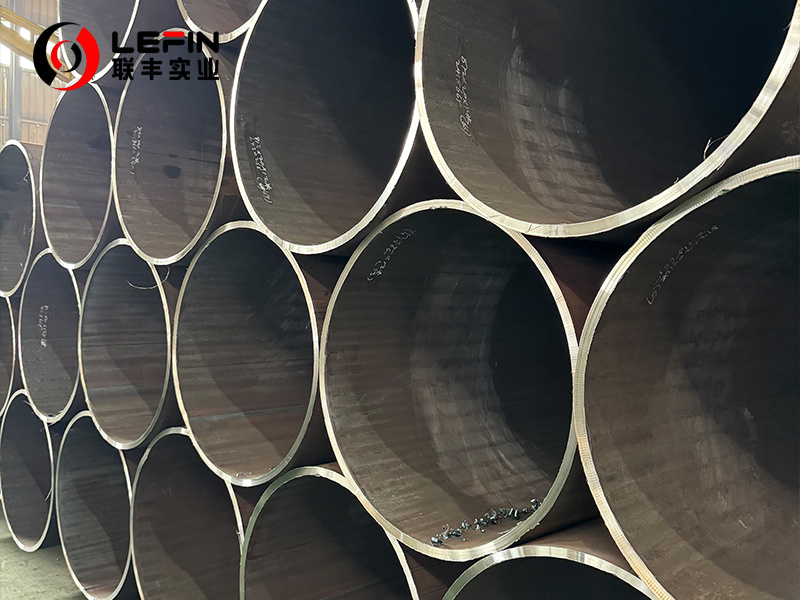
Maldives EN10210 STEEL PIPES
Product Description
EN10210 STEEL PIPES
BRIEF INTRODUCTION
Overview of standards:
The EN10210 series standards are technical specifications developed by the European Union for hot rolled hollow structural profiles and belong to the harmonized standards of the European Union Construction Products Regulation (CPR 305/2011/EU). It is mainly applicable to buildings (such as houses, Bridges, offshore platforms, etc.) and load-bearing structures in civil engineering, and specifies the delivery technical conditions and conformity assessment methods of hot rolled steel pipes (round, rectangular, square rectangular, oval, etc.).
Product range and typical steel types:
1. Applicable products
• Outer diameter range: ≤2500mm, wall thickness ≤120mm.
• Typical steel grades include:
• Non-alloy steel: S235JRH, S275J0H, S355J2H, etc.
• Fine grain steel: S275NH, S355NLH, S460NH, etc.
2. Material classification
• The difference between unalloyed steel and fine-grained steel is the chemical composition and grain refinement process, the latter by adding aluminum (Al), niobium (Nb), vanadium (V) and other elements to improve strength and toughness.
Technical requirements
1. Dimensional tolerance
• Outer diameter tolerance: ±1% (min. ±0.5mm, Max. ±10mm)
• Wall thickness tolerance: -10% (positive deviation is limited by weight);
• Length tolerance: the size length (4m≤L≤6m) allows a deviation of ±10mm.
2. Chemical composition
• Example of unalloyed steel (S355J2H as an example) :
• C≤0.22%, Si≤0.22%, Mn≤1.60%, P≤0.030%.
• Fine grain steel example (S460NH as an example) :
• C≤0.22%, Al≥0.2%, V≤0.2%, and control N≤0.025%.
3. Mechanical properties
• Yield strength: Minimum values range from 235MPa (S235JRH) to 460MPa (S460NH) for different steel grades;
• Tensile strength: For example, the tensile strength of S355J2H is 470-630 mpa (wall thickness 40-65mm).
4. Other requirements
• Weldability, impact performance, surface status (no cracks, oxide, etc.), hazardous substance content (such as RoHS restrictions).
Application fields:
EN10210 steel pipe is widely used in:
• Building steel structures (such as stadiums, high-rise buildings);
• Construction machinery (crane boom, excavator structure);
• Load-bearing components for offshore platforms and Bridges.
CHEMICAL COMPOSITION
Unalloyed hollow section steel for steel structure | |||||||
Analyze the melting chemical composition of products with thickness ≤65mm | |||||||
GRADE | COMPOSITION % MAX | ||||||
C | Si | Mn | P | S | N | ||
Nominal thickness≤40mm | 40mm<Nominal thickness≤65mm | ||||||
S235JRH | 0.17 | 0.20 | - | 1.40 | 0.045 | 0.045 | 0.009 |
S275J0H | 0.20 | 0.22 | - | 1.50 | 0.040 | 0.040 | 0.009 |
S275J2H | 0.20 | 0.22 | - | 1.50 | 0.035 | 0.035 | - |
S355J0H | 0.22 | 0.22 | 0.55 | 1.60 | 0.040 | 0.040 | 0.009 |
S355J2H | 0.22 | 0.22 | 0.55 | 1.60 | 0.035 | 0.035 | - |
PHYSICAL REQUIREMENTS
Mechanical properties of unalloyed steels | |||||
GRADE | Yield strength | Tensile strength | |||
Nominal thickness≤16 | 16<Nominal thickness≤40 | 40<Nominal thickness≤65 | Nominal thickness<3 | 3≤Nominal thickness≤65 | |
S235JRH | 235 | 225 | 215 | 360-510 | 340-470 |
S275J0H | 275 | 265 | 255 | 430-580 | 410-560 |
S275J2H | |||||
S355J0H | 355 | 345 | 335 | 510-680 | 490-630 |
S355J2H | |||||
THE DIFFERENCE BETWEEN DIFFERENT STEEL GRADES
Different steel grades (such as S235JRH, S275J0H, S355J2H, etc.) the main difference
Different steel grades under the EN10210-1 standard (such as S235JRH, S275J0H, S355J2H, etc.) are mainly different in mechanical properties and chemical composition, which directly affects the difference in their application scenarios.
The core difference of steel grade
1. Yield strength and tensile strength
• S235JRH: Minimum yield strength of 235 MPa, tensile strength of 360-510 MPa, suitable for low load scenarios.
• S275J0H/S275J2H: Yield strength 275 MPa, tensile strength 430-580 MPa, moderate strength, taking into account economy and performance.
• S355J0H/S355J2H: Yield strength 355 MPa, tensile strength 510-680 MPa, suitable for high load or dynamic stress environments (such as Bridges, heavy support structures).
2. Chemical composition difference
• The content of carbon (C), manganese (Mn), phosphorus (P), sulfur (S) and other elements of different steel grades is strictly limited. For example, the S355 series has a higher manganese content, which improves strength and toughness.
3. Impact toughness requirements
• The suffix "J0H" means that the steel grade needs to meet the impact toughness test at 0℃, and the "J2H" requires low temperature impact performance at -20℃ (such as S355J2H is suitable for cold areas).
Application differences
1. Conventional building structure
S235JRH: For non-load-bearing or low-stress components (e.g. enclosures, small brackets).
• S275J0H: Common in ordinary steel frame, floor support and other medium load scenarios.
2. High load or dynamic environment
• S355J2H: It is preferred for Bridges, high-rise building core supports, and industrial plant trusses that need to withstand heavy loads or vibration.
3. Low temperature environment
• Steel grade with "J2H" suffix (such as S355J2H) : suitable for cold areas or low temperature storage facilities, because of its low temperature impact toughness.
The selection basis
• Load requirements: Select S355 series for scenarios with high loads.
• Ambient temperature: Low temperature environment should pay attention to steel grade suffix (J0H/J2H).
Cost balance: The S235/S275 series is low cost and suitable for non-critical structures.
The steel grade classification of EN10210-1 provides a clear performance matching standard for engineering design, which needs to be comprehensively evaluated according to the specific project requirements.
Address: Hengtai Road,Daqiuzhuang Town,Jinghai County,Tianjin,China
Mob: +8615122229899(whatspp)
Phone: +86 22 58171905
Fax: +86 22 58171902
E-mail:info@lefinsteel.com
Get company updates
Tianjin Lefin Industrial Co.,Ltd. All rights reserved City sub-station SEO www.300.cn